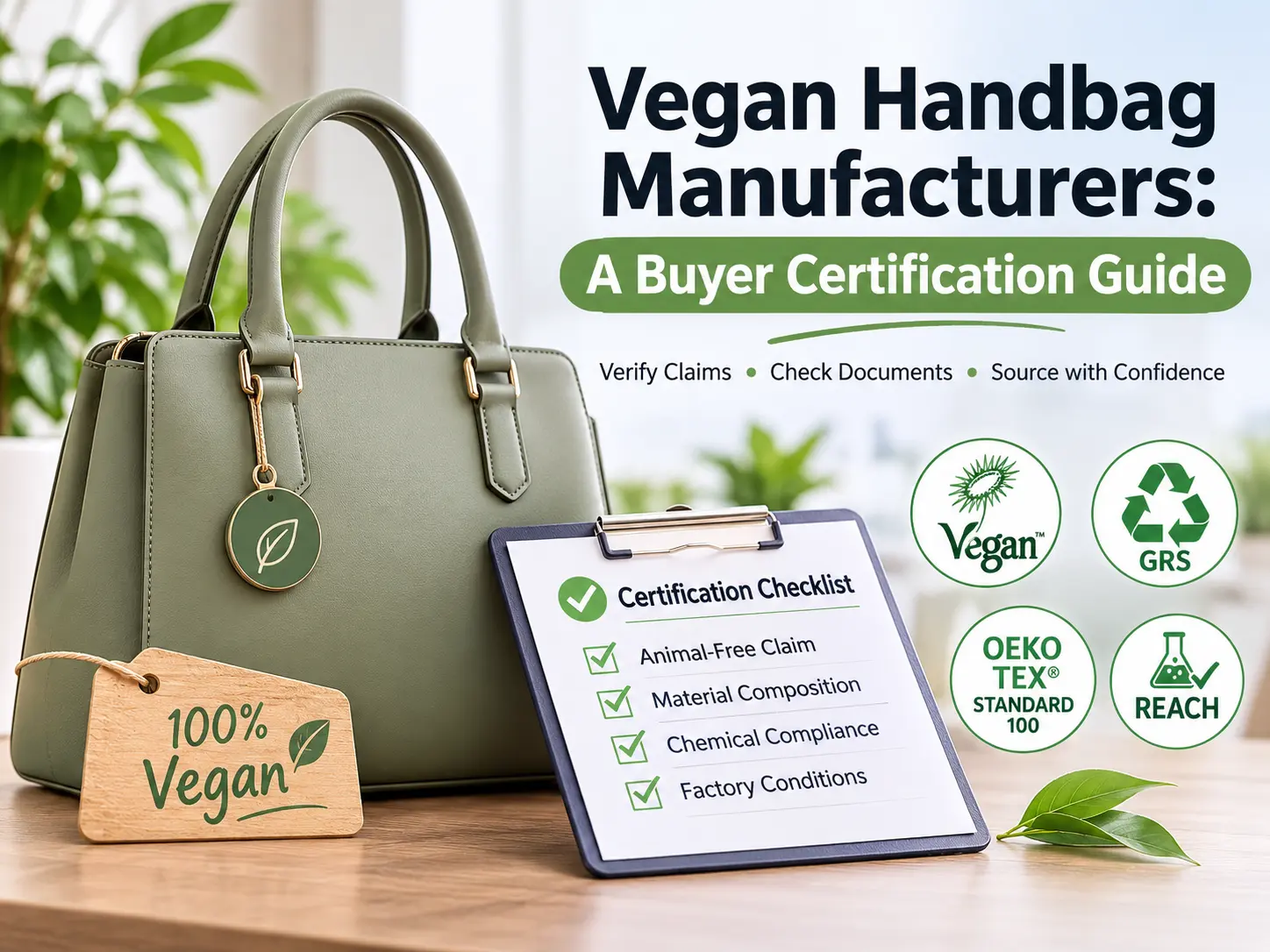
The word “vegan” says little about a handbag’s recycled content, chemical compliance, or factory conditions. Buyers evaluating vegan handbag manufacturers should check each claim separately and confirm that the supporting document covers the material, product, site, or order in question.
This article outlines the main types of evidence and provides questions to include in a supplier request. The right documents depend on your destination market, retailer rules, and the claims you plan to make.
Why do buyers verify certifications before choosing a vegan handbag manufacturer?
Before requesting certificates, define what you need to verify: animal-derived inputs, material composition, chemical requirements, or factory conditions. These are separate checks, and one document will not normally cover all of them. Match each claim to evidence for the relevant material, product, or site.
For example, a textile test report may cover a fabric sample but exclude patches, adhesives, and the sewing facility. A social audit may assess factory practices without verifying the finished bag’s composition. Recycled-content records address the material’s source and chain of custody, not whether every component is animal-free.
Requirements also vary by market and buyer. An EU importer, a retailer with a restricted-substances list, and a brand using a vegan label may need different records. Write down the claim and applicable requirement first, then ask the supplier for documents that address them.
Keep the records connected. A factory audit identifies a site, a material certificate covers a defined input, and a bill of materials lists the product build. Your order file should link them to the approved style and production lot.
See the current handbag product range for the styles and categories available to buyers.
Which documents can substantiate a vegan handbag or material claim?
A product-specific bill of materials (BOM) and supplier declarations are the starting point for an animal-free claim. The Vegan Society’s Vegan Trademark and PETA-Approved Vegan are voluntary programs. Their assurance applies only when the named company or product falls within the program’s current scope. Confirm coverage with the program owner; a supplier’s general membership or marketing page is not enough.
Ask for a BOM covering the outer material, backing, lining, thread, labels, trims, hardware, adhesives, coatings, and packaging where relevant. The supplier declaration should identify the material or style codes and production version it covers. If it confirms only the face material, limit the claim to that material.
“Vegan leather” is not a full composition statement. Request the trade name, composition, manufacturer, and converter. Ask whether the material uses a textile backing, polymer coating, recycled feedstock, or plant-derived content, and request evidence for those details.
Check other components if your claim covers the full product. These may include leather patches, wool or felt, silk, shell or bone details, animal-derived glues, waxes, dyes, or finishes. The supplier may need declarations from upstream vendors. Record any exclusions in the product file.
Vegan labels and supplier declarations are different forms of evidence. A label program applies its own criteria and licensing process; a declaration records a supplier’s statement about specified products or materials. Confirm label scope with the program owner and tie declarations to material codes, BOM revisions, and finished styles.
Compare available constructions with the site’s customization options.
What do GRS, OEKO-TEX, and REACH actually verify?
GRS, OEKO-TEX STANDARD 100, and REACH concern different matters: recycled content, harmful substances, and chemical regulation. None is, by itself, a vegan certification. Check the standard or legal requirement and confirm which material or component the document covers before using it to support a claim.
| Name | What buyers may use it to check | What it does not prove by itself | What to request |
|---|---|---|---|
| Global Recycled Standard (GRS) | Recycled content and chain-of-custody requirements within the applicable certification scope | That a material is animal-free or that every component in a handbag is covered | Current certificate scope and, where applicable, transaction documentation connecting the material to the purchase |
| OEKO-TEX STANDARD 100 | Whether covered textile articles or components were tested against the standard’s harmful-substance criteria | Vegan origin, full-product environmental impact, or factory social conditions | Certificate number, covered article/component, product class where relevant, and validity status |
| REACH | Compliance with applicable EU chemicals obligations for substances, mixtures, and articles | One universal “REACH certificate” or an animal-free product claim | Current, component-specific test reports or declarations that address the buyer’s applicable substance requirements |
| The Vegan Society / PETA-Approved Vegan | Whether a product or company is approved under the relevant voluntary vegan program | Recycled content, chemical compliance, or factory conditions | Current program listing or written confirmation for the named product and permitted logo use |
Textile Exchange maintains standards information for GRS. Confirm the current version and certificate scope with the organization and certificate holder. OEKO-TEX describes STANDARD 100 as a harmful-substance testing label for textiles. The European Commission describes REACH as a chemicals regulation, not a single product certificate. A folder of logos does not show which claims each document supports.
Use “plant-based” precisely. A material may contain plant-derived feedstock alongside synthetic backing or coatings. Ask what percentage the claim refers to, how it was measured, and which product layer it describes. Separate that evidence from any broader environmental claim.
GRS may support a recycled-content and chain-of-custody claim within its scope. OEKO-TEX STANDARD 100 addresses harmful-substance testing for covered articles, while REACH sets legal obligations for chemicals. None independently certifies a handbag as vegan. Connect each document to the relevant component in the approved BOM.
Review the site’s custom material options when evaluating available materials for a specific style.
Which factory certificates and audits matter for handbag sourcing?
Factory audits and management-system certificates assess a supplier or site. They do not establish a handbag’s animal-free composition. amfori BSCI addresses social compliance in supply chains, and SMETA is Sedex’s audit methodology. ISO 14001 concerns an organization’s environmental management system. Check the audited site’s identity, scope, date, and status.
Tie an amfori BSCI result to the legal entity and facility named in the audit. Request current report or authorized status information, the audit date, and relevant follow-up actions. A BSCI grade is not a product label and does not verify a vegan material claim.
Sedex membership and a SMETA audit are not product certifications. Check whether the report covers the factory making your handbags or another site in the supplier’s group. Confirm the audit type, date, scope, and corrective-action status through an authorized channel.
ISO 14001 covers an environmental management system within a defined organizational scope. It does not establish that a specific handbag has lower impacts or contains recycled inputs. Leather Working Group standards concern leather supply chains, not vegan materials.
Keenova’s company materials identify a BSCI Grade B rating. Buyers should request current audit evidence and confirm the audited entity, facility, date, and scope. This site-level evidence is separate from documentation about product materials.
Keep factory and material approvals separate. A valid social audit can inform your assessment of a facility, but it cannot replace missing BOM data. Link both approvals in the purchase record.
Learn more about the factory and production process.
How can buyers check certificate scope, validity, and traceability?
Check the issuer, certificate holder, site or material scope, covered process, certificate ID, dates, and current status. Then trace the document from the supplier or facility to the material lot and finished handbag SKU. Verify it with the issuing organization or its authorized directory; a PDF or logo alone is not enough.
Compare the certificate holder’s legal name and address with the factory or material supplier in your purchase documents. Confirm that the document covers the material category and processing stage you need. A certificate for one mill, facility, or fabric type may exclude subcontractors or coated versions.
For material evidence, connect the approved composition and supplier to the purchase order, lot or batch, and BOM revision. For test reports, check the sample description, component, date, laboratory, and requirements. Ask whether the evidence still applies if the color, coating, backing, or finish changes.
Ask the supplier: “Will you notify us and get written approval before changing an approved material supplier, composition, coating, or component?” Record the answer with the approved sample and technical pack so production teams can check substitutions before bulk production.
| Evidence record | Key fields to match |
|---|---|
| Factory audit | Legal entity, site address, audit date, scope, current status |
| Material certificate | Certificate holder, material category, processing scope, dates, status |
| Test report | Tested sample and component, method or requirement, lab, report date |
| Finished product BOM | Style/SKU, component codes, supplier, revision, approval date |
| Purchase and shipment records | Purchase order, approved material lot, production batch, shipment reference |
Use a certificate for an order only when its scope matches the input or site. Trace it from the issuer and certificate holder to the material code, approved BOM revision, and production lot. If a supplier, coating, or subcontracted process changes, request updated evidence before approving bulk production.
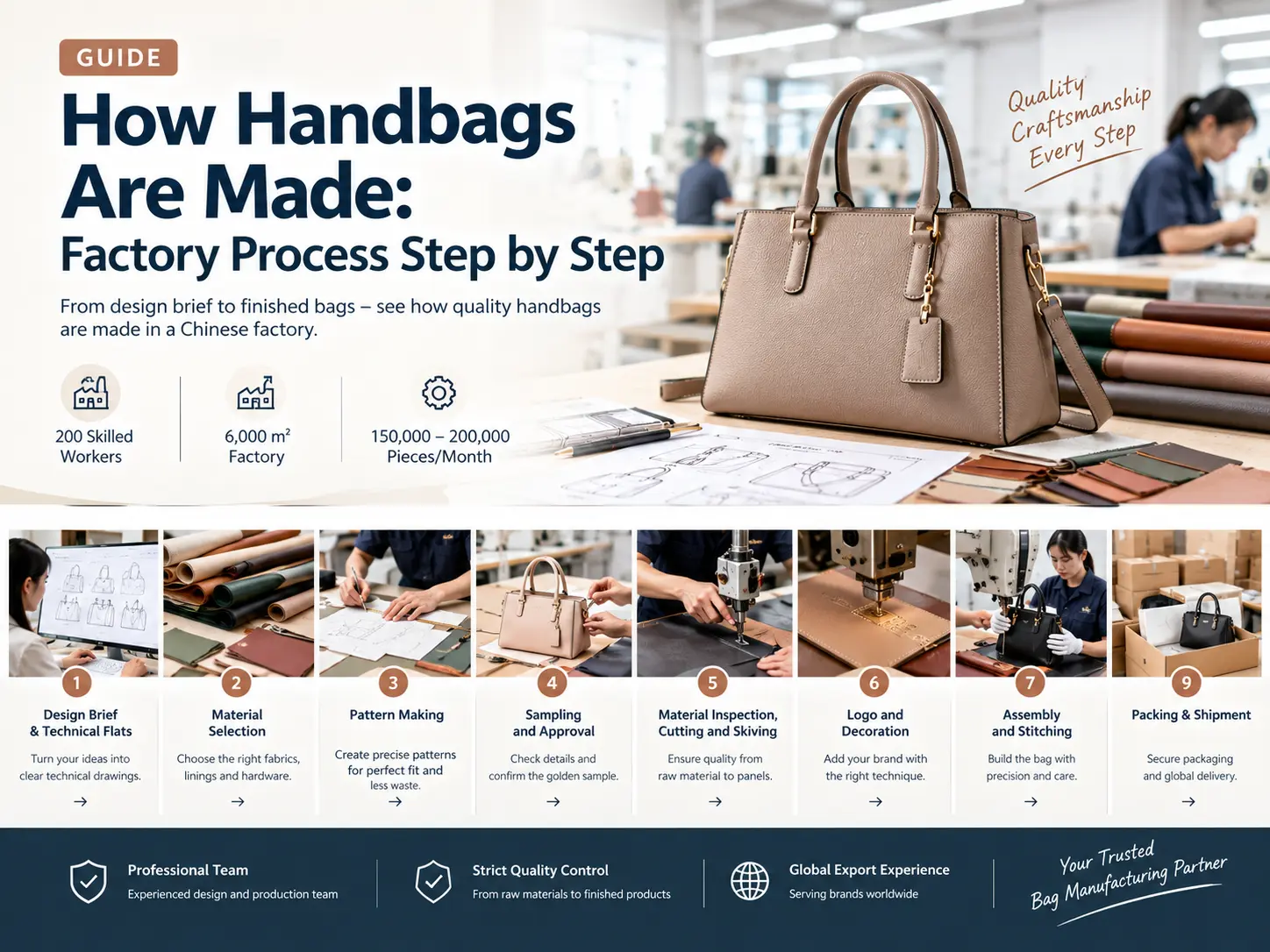
The site’s overview of how handbags are made describes the production process.
What should buyers ask a vegan handbag supplier before sampling?
Before approving a sample, request the material composition, full BOM, animal-free declarations, applicable certificates, and relevant test reports. Compare the evidence with the quoted design. Ask how the supplier will keep the approved material combination in place for repeat orders.
Send a short request with the RFQ:
- What is the trade name, composition, and manufacturer of each proposed bag material?
- Does the animal-free declaration cover the full BOM or only the outer material?
- Which certificate or voluntary vegan program applies to this material or finished style?
- Which site will produce the sample and bulk order, and what current audit evidence is available for that site?
- What chemical test reports or destination-market documents are available for the proposed components?
- If recycled or plant-based content is claimed, what percentage, layer, method, and records support it?
- How are approved suppliers and material lots identified during production?
- Will you notify us and request approval before any material, finish, or subcontractor changes?
Ask the supplier to label each attachment with the material code or style it supports. If evidence comes from an upstream mill or converter, request records linking that source to the material the factory will buy. Share any retailer or market checklist early and ask the supplier to identify gaps.
Review commercial terms alongside compliance. Confirm minimum quantities, color minimums, sampling and production lead times, inspection requirements, and any cost impact from specified materials or tests. The supplier should also explain whether it can reserve and trace the approved materials for repeat orders.
Keenova’s project records list PU as its primary material, alongside textiles and genuine leather. Ask which animal-free materials are available for a specific style and what supporting documents can be provided. The records do not show that every Keenova bag or material has vegan-specific certification.
Which certification red flags should trigger follow-up?
Pause approval if a document is generic, expired, unverifiable, or unrelated to the factory, material, SKU, or lot in your order. Ask the supplier to explain what it covers and excludes. Request clarification or testing before making a public claim or approving production when evidence is incomplete.
Watch for these signs:
- “Vegan certified” appears without a named program, product scope, license, or explanation of component coverage.
- A factory social audit is offered as proof that a handbag is animal-free.
- A chemical test report is presented as proof of recycled content, environmental impact, or vegan origin.
- The certificate holder or site differs from the factory or material source in your order.
- A recycled or plant-based claim has no composition, percentage, test method, or traceability record.
- The supplier cannot show how the approved material is protected from substitutions during production.
A mismatch may simply mean the document covers another site or material, or that the request was broader than the evidence. Ask the supplier to clarify the scope, correct the declaration, arrange independent testing, or propose another material. Record the decision with the approved sample and purchase documents.
Compare the document’s scope with the product claim. If they do not match, narrow the claim or request evidence that covers it. A valid certificate can still be irrelevant to the product under review.
For broader supplier due diligence, see this bag manufacturer sourcing guide.
Frequently Asked Questions
Is vegan leather automatically sustainable?
No. “Vegan” describes animal-derived inputs. It does not establish the material’s feedstock, coatings, chemical profile, durability, recycled content, or end-of-life options. Check those claims separately and avoid broad environmental language unless you have relevant evidence.
Does OEKO-TEX certify a handbag as vegan?
No. OEKO-TEX STANDARD 100 concerns harmful-substance testing for covered textile articles or components. It does not establish animal-free origin. Check the certificate scope and request separate evidence for a vegan claim.
Is a BSCI audit a product certificate?
No. amfori BSCI assesses supplier social practices. Verify the audited entity, factory site, audit date, and status. It does not certify a handbag’s material composition or prove the product is vegan.
What documents should I request from a vegan handbag manufacturer?
Request a product-specific BOM, material composition, supplier declarations, applicable vegan program listing or license, current certificate scopes, component test reports, site audit evidence, and change-control records. Match each document to the quoted style and production site.
Conclusion
Start with the claim, then request evidence that covers it. Vegan labels, recycled-content standards, chemical tests, and factory audits answer different questions. Verify the issuer and scope, and link the document to the material, site, SKU, and production lot. Keep the approved sample, BOM revision, and change notices with the order. Buyers can send Keenova a target style, destination market, material requirements, and retailer checklist through the contact page to confirm what documentation is available for that build.
Sources
- The Vegan Society: Vegan Trademark
- PETA-Approved Vegan
- Textile Exchange standards
- OEKO-TEX STANDARD 100
- European Commission: REACH
- amfori BSCI
- Sedex SMETA audit
- ISO 14001 environmental management
- Leather Working Group
Confirm current program requirements, certificate status, destination-market rules, and retailer requirements before publication or use in a product claim.

Zack is a custom bag specialist at Keenova, a leading integrated manufacturer and exporter of custom bags in China. With deep expertise in bag design, material selection, and OEM/ODM manufacturing processes, Zack helps global brands, retailers, and wholesalers navigate complex bag structures and find tailored, high-quality factory solutions.