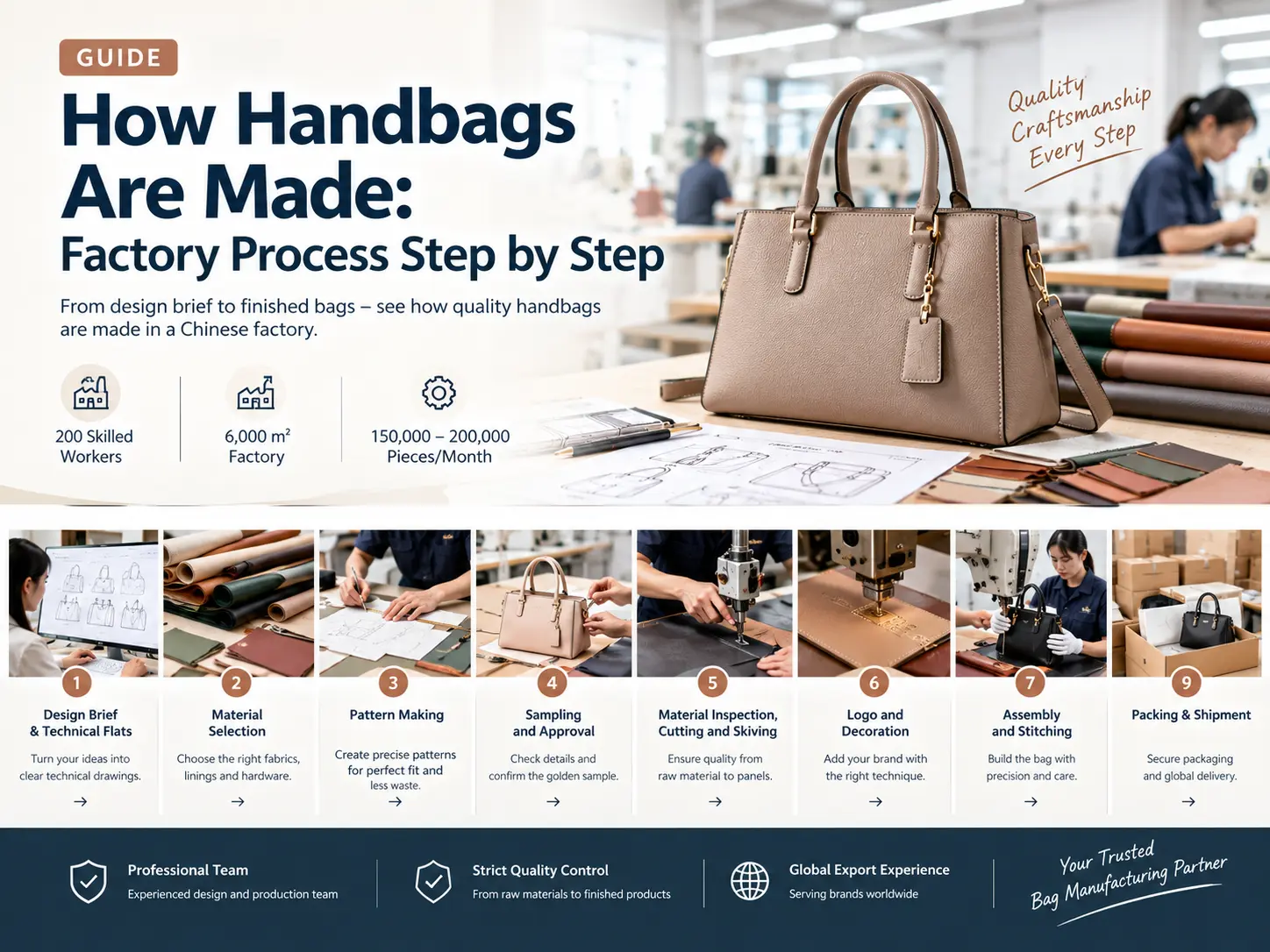
Every handbag on a retail shelf passed through the same nine stages before it reached the store. Most buyers only see the finished product, which makes it hard to judge whether a factory’s timeline, quote or sample is realistic. This walkthrough follows the actual production flow at Keenova’s 6,000 m² factory in Guangzhou, where 200 skilled workers turn a sketch into finished bags at a rate of 150,000 to 200,000 pieces per month. Understanding the sequence helps you write a better brief, approve the right sample and set a delivery date your customers can count on.
The Handbag Manufacturing Process at a Glance
| Phase | Steps | What you receive | Output |
|---|---|---|---|
| Development | Step 1 to Step 4 | Technical flats, confirmed materials, production patterns, approved sample | One golden sample |
| Production | Step 5 to Step 8 | Cut panels, decorated parts, assembled bodies, finished edges | Finished bags |
| Finishing and delivery | Step 9 | Inspected goods, branded packaging, cartons | Shipment |
Step 1: Design Brief and Technical Flats
Development starts with a brief, not a sketch. A usable brief covers the target customer, the intended retail price, the dimensions, the carrying method, the capacity, the interior layout and a few reference photos. With that information, the in-house design team can produce technical flats within 24 hours.
Under an OEM project you supply the tech pack or a physical reference sample and the factory builds to it. Under an ODM project the design team develops the structure with you, which suits brands that have a concept but no technical drawings. Keenova’s design team releases more than 200 new styles every month, so many buyers start from an existing base and modify it.

Step 2: Material Selection
Outer materials cover nylon, polyester, cotton, canvas and PU leather. Each behaves differently on a production line: canvas and polyester are predictable and cost-efficient, while PU leather requires consistent surface grain and thickness across the whole roll to avoid visible variation between bags.
The same decision applies to what you do not see. Lining fabric, interlining and reinforcement layers determine whether a structured tote holds its shape or slumps after a month. Colors are matched to any Pantone code, and custom dyeing supports metallic, gloss and matte finishes.
Material choice is also the biggest cost lever. It sets the unit price, the usable cutting area and how flexible the minimum order can be.
Step 3: Pattern Making
Pattern making converts a flat drawing into the templates that the cutting room works from. Keenova keeps this work in an independent in-house pattern room rather than outsourcing it, which is why sample and bulk versions match.
The pattern maker also plans the cutting layout to minimise waste and grades sizes when a style runs in more than one dimension. Most structural problems are solved or created at this stage. A pocket placed too deep, a strap attachment that cannot take load or a flap that will not close flat all trace back to the pattern, and all are far cheaper to fix here than on the line.

Step 4: Sampling and Approval
The first sample is built in the pattern room in 7 to 10 working days. Review it against real conditions: check the silhouette, the stitch line, the strap drop on a shoulder, the hardware position, the effort needed to open the closure and the interior layout with a phone and wallet inside.
Send revision comments as a written spec list with marked-up photos, because verbal or vague feedback tends to restart the development clock. Once the sample is approved it is sealed and archived as the golden sample, and bulk production is measured against it.
Step 5: Material Inspection, Cutting and Skiving
Incoming material is inspected before cutting, checking color consistency, thickness, coating defects and delivered quantity. A defect found in the roll costs meters; the same defect found after cutting costs finished bags.
Panels are then cut to the planned layout, with grain direction and pattern matching controlled. Skiving thins the edges of panels so seams lie flat and hardware sits correctly, and reinforcement is bonded to load-bearing areas. Panels for each bag are bundled and numbered so parts never mix between units.
Step 6: Logo and Decoration
Logo work happens on flat panels, before assembly, because a finished bag cannot be printed evenly. Available methods include screen printing, digital printing, embroidery, rubber patches, metal emblems, embossing and debossing, and woven labels.
The right method depends on the material and on positioning. Embroidery reads as premium on canvas but can pucker thin PU, and a debossed logo disappears on high-pile fabric. Packaging elements such as hangtags, labels and dust bags are developed alongside the logo.
Step 7: Assembly and Stitching
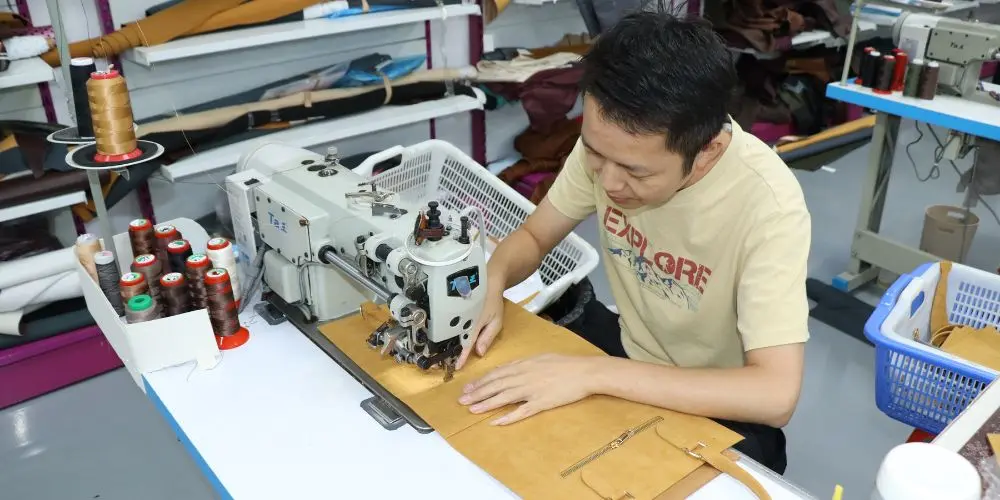
The line builds in sub-assemblies. Pockets, straps and zipper panels are prepared first, then the body is assembled, then the lining is inserted and closed. Each worker handles a defined operation, which is how 200 workers maintain consistent output across a 150,000 to 200,000 piece month.
Stitch density, thread type and seam construction matter most at load-bearing points: strap attachments, handle roots and the base seam. These are the areas a wearer tests first and the areas worth specifying in the tech pack.
Step 8: Hardware and Edge Finishing
Hardware follows the panels. Zippers, buckles, magnetic closures and feet are fitted, with custom-molded zinc-alloy parts available in brushed-gold, silver and antique finishes.
Edge finishing is the last craft stage. Edge painting is applied in several thin coats with drying time between passes; rushed edge work is the most common reason a bag looks worn within a season. Binding and topstitching are alternatives where the design or the material calls for them.
Step 9: Quality Control, Packing and Shipment
Inspection runs during production, not only at the end. An independent QC team checks raw materials, workmanship and finished goods, and every order is verified against the approved golden sample before packing.
Goods are then cleaned, thread trimmed, stuffed to hold shape and packed in individual polybags, followed by hangtags, labels, dust bags and cartons according to the private label spec. Keenova builds to the requirements of European, Russian and Latin American markets and currently ships to Russia, Spain, Italy and Poland.

How Long Does the Whole Process Take
| Stage | Duration |
|---|---|
| Technical flats | 24 hours |
| Sampling | 7 to 10 working days |
| Sample revisions | Depends on the number of rounds |
| Bulk production | Quoted per order, based on quantity, material and decoration complexity |
| Packing and shipment | Confirmed before the order is booked |
Two external variables affect this more than anything inside the factory. The first is how quickly you return sample comments, since each revision round adds a cycle. The second is the calendar: sampling and production capacity around Chinese public holidays should be booked early.
Where Buyers Lose Time and Money in This Process
| Mistake | What it costs | The fix |
|---|---|---|
| A brief that says “premium bag” with no dimensions, material or target price | Sampling rounds spent finding the shape before development can even start | Send size, material, hardware finish and target retail price in the first email |
| Approving a sample from photos | Bulk arrives with a different handfeel, or a strap that sits too long | Review a physical sample under retail lighting, loaded with what the bag will really carry |
| Changing the material after the BOM is locked | Re-sourcing, new supplier minimums and a second sampling cycle | Confirm the material and the Pantone code before the first sample is cut |
| Skipping the sealed golden sample | No reference for the QC team and no ground for a claim after shipment | Seal the approved sample and write the spec into the contract |
| Choosing hardware for looks alone | Zippers that jam, plating that wears through, returns from the retail floor | Specify custom-molded zinc-alloy hardware and finishes, and ask for a pull test on the line |
| Booking production without a slot | The order queues behind earlier bookings, which gets worse around Chinese public holidays | Lock the production slot when you pay the deposit, not when you approve the sample |
Every one of these is cheaper to fix in development than in bulk. A material change on paper costs an email, and the same change after cutting costs the panels already on the table.
What to Confirm Before You Place a Bulk Order
- Approved sample: sealed golden sample with all changes documented in writing
- Locked BOM: materials, hardware finish, thread and lining confirmed, not “equivalent”
- MOQ: from 300 pieces per color at Keenova
- Logo and packaging: method, placement, hangtags, labels, dust bags and carton spec
- Inspection standard: what the final check covers and how the result is reported
- Delivery date: written into the contract, with the compliance documents your market needs
Keenova’s production is BSCI Grade B certified. If you sell into a market with additional chemical or labelling rules, raise them at the brief stage so the material and packaging can be planned for them.
FAQ
What is the minimum order quantity for custom handbags?
Keenova starts at 300 pieces per color. The final workable quantity depends on the material, the hardware and how complex the construction is, because small runs of a complicated style use the same setup time as a large one.
Can you make a bag from just a photo or a sketch?
Yes. Under an ODM project the in-house design team develops the structure from a concept or reference image and returns technical flats within 24 hours. Under an OEM project you supply a tech pack or physical sample and production follows it.
Which materials can I choose from?
Nylon, polyester, cotton, canvas and PU leather, with matching lining and reinforcement options. Colors are matched to any Pantone code, and finishes include metallic, gloss and matte.
How long does sampling take?
7 to 10 working days in the independent pattern room. Revision rounds are added on top, so the fastest projects are the ones with a complete brief and consolidated feedback.
What brand elements can you add?
Screen printing, digital printing, embroidery, rubber patches, metal emblems, embossing, debossing and woven labels, plus custom-molded zinc-alloy hardware and a full private label packaging set.
From Brief to Bulk Order
Nine stages sit between a sketch and a carton, and the ones that cost the most time are the earliest. A complete brief, a locked material list and consolidated sample comments will shorten your timeline more than anything the factory can do on its own.
If you want a process you can follow from the first sketch to the final carton, request a custom bag solution or download the current catalog to see the factory-direct handbag range.

Zack is a custom bag specialist at Keenova, a leading integrated manufacturer and exporter of custom bags in China. With deep expertise in bag design, material selection, and OEM/ODM manufacturing processes, Zack helps global brands, retailers, and wholesalers navigate complex bag structures and find tailored, high-quality factory solutions.