Two suppliers can quote the same tote, backpack, or crossbody and still be pricing different bags. One may assume stock hardware; another may price custom hardware. One may include a lining, while the other leaves it out. Buyers often discover those differences only after the sample arrives, when time has already gone.
Choosing a bag manufacturer in China starts with proof. The headline price comes later. Wholesale buyers need to see how a supplier reads the brief, controls a sample, checks bulk production, and explains the conditions behind MOQ and timing.
Key Takeaways
- A reliable bag manufacturer is not defined by a low quote or a broad catalog. Buyers should verify category-specific production evidence, factory identity, and the people responsible for development before moving forward.
- Compare quotes only after every supplier has received the same RFQ. Record the assumptions behind materials, lining, hardware, logo application, packaging, quantity per color, inspection, freight, and delivery terms.
- Treat MOQ as a production condition. The workable minimum can change with the bag style, colorways, materials, custom hardware, branding method, and packaging requirements.
- Use the sample stage to confirm the details that photos cannot reliably settle: dimensions, material feel, color, structure, stitching, logo placement, hardware function, lining, and packaging fit. Keep a dated revision record before bulk release.
- Build QC into the order from the start. Agree on the approved reference sample, measurable tolerances, defect rules, inspection method, packaging checks, and who can approve, rework, or stop a shipment.
- Separate factory-management evidence from product compliance. Audit status, test reports, labels, packaging, and destination-market requirements each need their own review.
- A realistic delivery plan shows approval gates, material booking, production, packing, inspection, export documents, and shipping. The next decision and its deadline should always be visible.

What makes a bag manufacturer in China reliable?
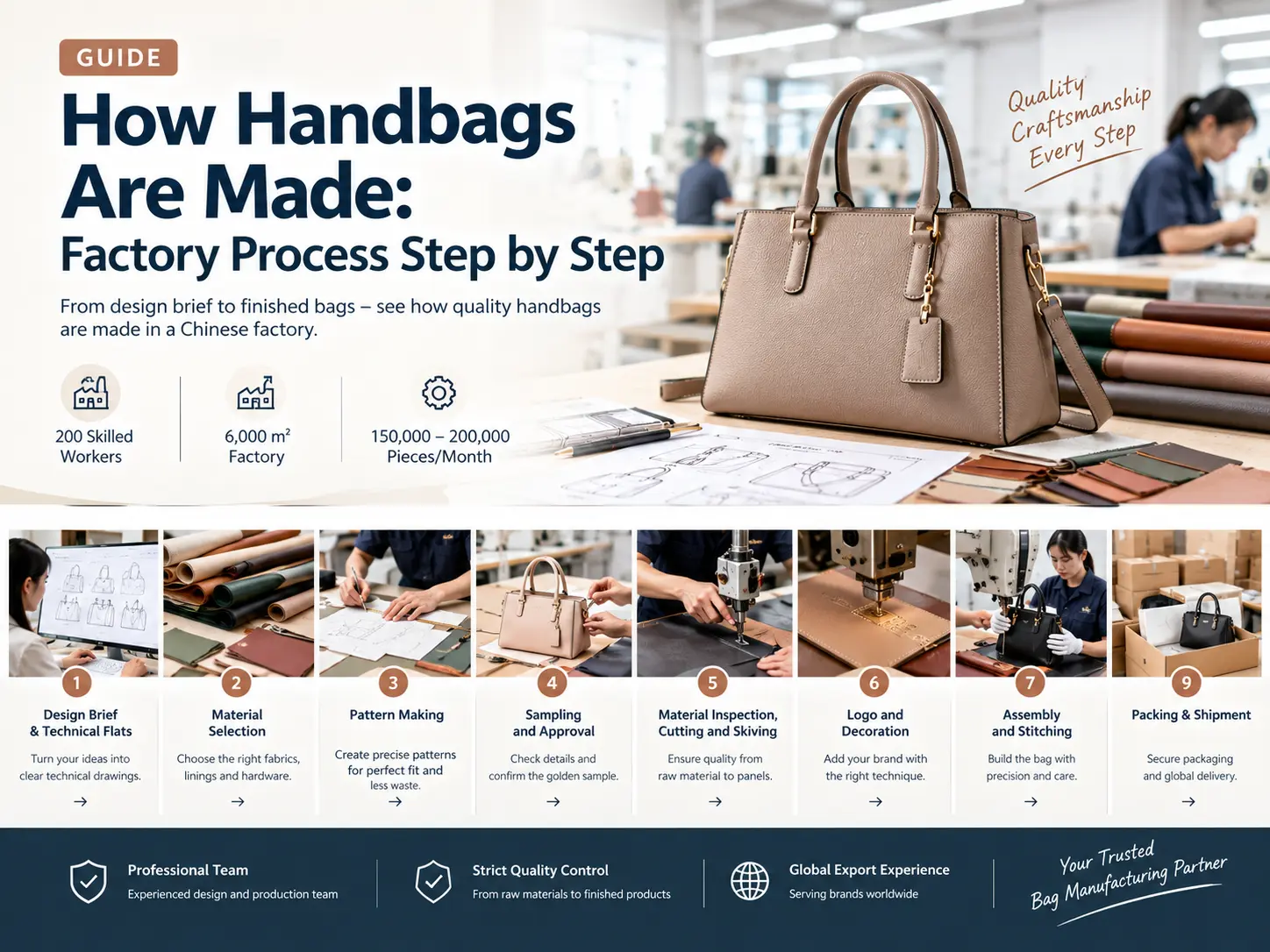
A reliable supplier can show how it converts an approved specification into an inspected shipment. For example, KEENOVA’s approved process names checks for materials, pre-production samples, production lines, packaging, and final shipment inspection. That sequence matters more than a catalog, a badge, or a low opening quote.
In practice, reliability shows up in ordinary questions. Can the supplier make this type of bag? Does the quotation state its assumptions? Is there a physical sample and a revision record? Is the inspection plan clear? Can the team explain which documents apply to the destination market? Those are the checks that matter.
I keep coming back to four handoffs: brief to technical review, technical review to approved sample, approved sample to bulk reference, and bulk reference to inspection and packing release. Each one leaves a trail of evidence. If a supplier cannot explain one of them clearly, leave it open on your risk list rather than guessing the answer.
Use a 20-point verification scorecard
Score each question below from 0 to 2: 0 means no relevant evidence, 1 means partial or unclear evidence, and 2 means current, relevant, documented evidence. The score does not guarantee an outcome. It helps your buying team compare the same proof across suppliers.
| Verification question | 0 points | 1 point | 2 points |
| Can it show relevant bag-category work? | Generic catalog | Similar examples | Current, comparable evidence |
| Is the production setting clear? | Unclear identity | Partial tour/details | Current address and production proof |
| Is the RFQ complete? | Photo and quantity only | Some specifications | Written product and market inputs |
| Are quote assumptions visible? | Lump-sum quote | Some exclusions | Itemized inclusions and exclusions |
| Is the MOQ basis stated? | One number only | Partial basis | Style, color, material, and component basis |
| Is there an approved sample? | None | Photos only | Physical reference and sign-off |
| Are revisions controlled? | Verbal changes | Informal notes | Dated version record |
| Is QC planned? | Final check only | General promise | Staged checkpoints and acceptance plan |
| Are market documents matched? | Generic certificate | Partial document set | Product/material/market-specific review |
| Is timing staged? | One date only | Basic lead time | Approval, production, inspection, and shipment plan |
1. Can the supplier prove it makes your bag category?
Ask for evidence of the actual production setting and the category you need. A structured handbag, soft tote, backpack, cosmetic bag, travel bag, wallet, and functional bag all call for different construction and components.
Start with a current factory address. Then request a live video call, or at least a recent dated walk-through of the sample room and relevant production area. Ask to see comparable finished products, material handling, and the people who will turn your reference image or tech pack into a sample. A good remote review should leave you with clearer questions, not more fog.
Evidence to request when you cannot visit China
Ask for recent footage instead of relying on a heavily edited corporate video. Check whether the line shown handles your bag category, material, hardware, and planned quantity. Then speak with a development or production contact. You will quickly hear whether the team is thinking about construction and use, or simply repeating your target price.
Category fit beats a broad catalog
A wide catalog is not proof of fit. If you are developing a structured shoulder bag, ask for work that shows similar panels, edge finishing, hardware attachment, lining, and load points. If you are buying travel bags, ask about reinforcements, zippers, webbing, and carrying loads. There is no universal “good factory” answer.
2. Does the factory turn your brief into written quote assumptions?
A useful quote begins with a usable brief. KEENOVA plans samples in 7–10 days from a confirmed design. That condition is a good sourcing test: a supplier should identify what needs confirmation before it can price and schedule accurately.
Your RFQ should cover the bag category and use, reference image or tech pack, finished dimensions, outer material, lining, colorways, logo method, hardware, packaging, quantity per color, target market, and target delivery date. Include the requested incoterm if you know it. If you do not, ask the supplier to say exactly what shipping scope the quote assumes.
Required information before a meaningful quote
| Group | Provide before quote | Why it changes the answer |
| Product | Reference, dimensions, use, structure | Determines materials and construction |
| Brand | Logo file, method, position | May affect tooling and process |
| Order | Quantity by style and color | Determines MOQ and material planning |
| Market | Destination and delivery date | Affects documents, labeling, and schedule |
Ask suppliers to put their assumptions in writing. If the lining, hardware finish, material grade, packaging, inspection standard, or freight scope is still open, label it provisional.
Production-review prompt: In a real sample review, ask the team to restate the bag: dimensions, material, lining, color, logo, hardware, packaging, quantity per color, and delivery market.
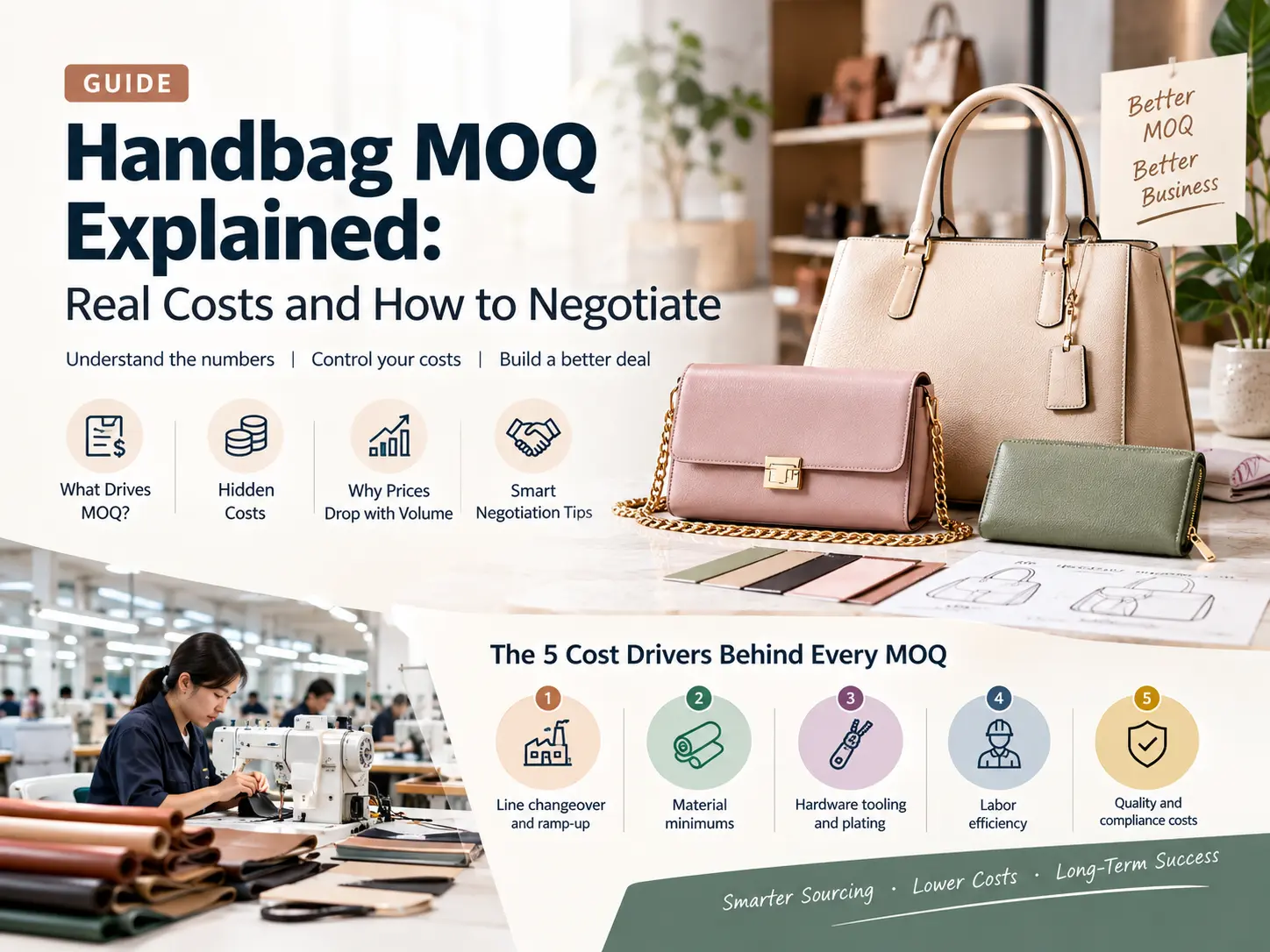
3. How should buyers compare MOQ and price without missing cost drivers?
Custom color lots, new hardware, molds, logo applications, complex construction, testing, and retail packaging can change the cost or order sequence. That does not make a supplier a poor fit. It tells you what belongs in the comparison. A cheap quote is no bargain if it leaves out the detail that makes the bag recognizably yours.
Compare the MOQ basis before comparing the number
Ask whether the minimum is calculated by style, color, material, hardware component, packaging item, or total order. Record the answer. A total order of 1,000 bags spread across five colorways may not meet the material or color minimum for each version.
Keep one-off costs separate from unit price
| Quote field | Question to ask |
| Unit price | What exact specification does this price cover? |
| Sample charge | Is it credited against a confirmed order? |
| Tooling | Which molds, plates, or custom components need it? |
| Packaging | What is included per bag and per carton? |
| QC/inspection | Which checks and evidence are included? |
| Payment | What are the milestones and conditions? |
| Freight/terms | Is freight included? Which incoterm applies? |
| Exclusions | What could change after sample approval? |
4. What should happen before you approve a bag sample?
Keep the sequence simple: brief review, quote assumptions, material and component review, first sample, documented revisions, approved sample or pre-production sample where appropriate, then bulk release. Photos help when the team is remote. They cannot always show material hand-feel, color variation, balance, or hardware operation.
What to approve on the physical sample
Check dimensions, silhouette, material appearance and hand-feel, color under agreed lighting, stitch quality, logo position and legibility, hardware function, strap comfort, lining, pocket layout, and packaging fit. Make the checklist specific to the product. A laptop backpack needs a different review from a cosmetic pouch.
Record revisions before bulk production
Give each change a date and version. Say which sample is the production reference. Record approved materials, components, artwork, measurement tolerances, packaging, and packing marks. If a detail is still open, do not bury it in an email thread. Put an owner and due date against it.
5. What quality-control plan should a wholesale buyer require?
QC should be agreed before production and checked at several stages. A buyer should ask any manufacturer to name comparable checkpoints, the evidence provided, and what happens when a check fails.
Do not settle for “we inspect everything.” Agree what must match the approved reference: measurement tolerances, appearance, stitching, logo position, hardware function, color, lining, packaging, carton marks, and defect classification. If you use AQL or another sampling plan, put it in the purchase order or QC documentation. One number does not suit every product.
The five QC checkpoints
| Stage | What to check | Evidence / decision |
| Materials | Color, finish, quantity, agreed specification | Hold or replace nonconforming materials |
| Pre-production reference | Construction, dimensions, branding, components | Approve, revise, or stop bulk release |
| During production | Assembly, stitching, measurements, function | Correct the line before defects multiply |
| Packaging | Labels, dust bags, cartons, marks, protection | Correct packing before final release |
| Final inspection | Agreed sampling and acceptance requirements | Release, rework, or resolve exceptions |
If you use AQL or another sampling plan, document the agreed inspection method, sample size, defect classifications, acceptance criteria, and decision owner in the purchase order or QC plan. Do not rely on a generic standard reference unless the buyer and supplier have confirmed the applicable edition and its use for the order. Define first, inspect second.
6. Are compliance documents matched to the bag and destination market?
A factory social-audit result and a product-compliance document answer different questions.
Ask which documents apply to the selected product and market. Confirm the document name, issuer, issue date, scope, product or material coverage, and factory linkage. Check that it matches the final construction rather than an earlier material choice. This is particularly important when materials, coatings, labels, packaging, or destination markets change after sampling.
For EU-bound consumer goods, the EU General Product Safety Regulation has applied since 13 December 2024 (Regulation (EU) 2023/988). Buyers should obtain current qualified advice on the requirements for their product, including applicable traceability, responsible-person, and consumer-information duties.
Questions to ask before relying on a document
- Is the document for this factory, material, product, and destination market?
- Does the issue date and scope remain current for the final bag?
- Which label, packaging, testing, or technical-file inputs must the buyer provide?
- Who owns the review before shipment?
7. Can the factory give you a realistic production and shipment plan?
A credible delivery plan identifies the approvals and dependencies before it gives a date.
Ask for stages: design confirmation, sample revisions, material booking, production, packing, inspection, export documents, booking, and shipment. Then ask which buyer decision is needed next and what date it protects. A late artwork file or hardware change can affect a schedule very differently from a small carton-mark correction.
Separate factory time from the full delivery plan
Production time is only one part of delivery. Inspection, export documents, transport booking, transit, destination handling, and customs each take their own turn. Build a calendar with those stages and name the owner for every approval. It is dull paperwork. It is also what keeps a launch date from drifting.
The useful schedule is not the one with the shortest headline number. It is the one that shows the next dependency. When a buyer can see the next decision, the team can prevent a delay instead of explaining one later.
8. Use these 10 questions before you release a bulk bag order
Before a bulk commitment, score the same proof across every shortlisted supplier. Your own scorecard should add the commercial, sample, compliance, and scheduling evidence that makes those checks actionable.
Use this last review before you release bulk materials or a large payment:
- Can the supplier show current evidence for your bag category?
- Is its actual production setting and role clear?
- Did it receive a complete RFQ?
- Are quotation assumptions and exclusions written down?
- Is the MOQ basis stated by style, color, materials, and components?
- Have you approved a physical sample where the product risk requires one?
- Is there a dated revision or pre-production reference record?
- Is the QC plan staged and measurable?
- Are market documents matched to the final bag and destination?
- Does the schedule name approvals, production, inspection, and shipment steps?
To help you further refine your bag procurement strategy, material selection, and product lineup, explore our related guides below:
| Related Guide | What You Can Learn |
| Factory vs Trading Company for Bags: Which Supplier Should You Choose? | Learn the key differences between direct bag manufacturers and sourcing agents to optimize your procurement costs and MOQs. |
| Top 5 Leather Bag Styles That Sell Best in Wholesale | Discover high-performing wholesale leather bag designs to align your inventory with market trends and buyer demand. |
| Leather Grades vs. Budget: The Wholesale Buyer’s Sourcing Guide | Understand different leather quality grades and cost breakdowns to select the right materials within your target budget. |
Frequently asked questions
How can I verify whether a bag supplier is a factory?
Request a current address, a live or recent production walkthrough, category-relevant samples, and a conversation with the development or production contact. KEENOVA operates a 6,000 m² production site with 200 skilled workers; any supplier should be able to provide equivalent, current evidence that matches your bag category.
What should a bag QC checklist include?
Include materials, measurements, construction, stitching, logo placement, hardware operation, color, lining, packaging, carton marks, and the agreed acceptance plan.
Does a BSCI audit prove a bag meets EU or US product rules?
No. A BSCI Grade B result is a factory social-compliance and management signal, while product requirements depend on the bag, materials, labeling, and destination market. Confirm current market-specific obligations with qualified compliance support before shipment.
Choose evidence before you choose a quote
The order is simple: prepare a full RFQ, compare each supplier’s written evidence and assumptions, then approve a sample and QC plan before bulk release.
KEENOVA is an OEM/ODM bag manufacturer with 15 years of experience and a 6,000 m² BSCI-certified facility producing 200+ new bag styles each month.
Contact and share your reference image, target quantity, material preferences, and delivery market. We will review the practical next step with you.

Ivy is a custom bag specialist at Keenova, an integrated manufacturer and exporter of custom bags in China. She shares practical knowledge on bag design, material selection, and OEM/ODM manufacturing processes. She helps global brands, retailers, and wholesalers understand bag structures and choose the right factory solutions.