A bag factory can be the right supplier. So can a trading company. It depends on who is responsible for the technical work, the commercial details, quality checks, and export steps on the bag you plan to buy.
Work that out before sample approval, not after a production issue. A supplier may call itself a factory, a sourcing company, or both. Your team needs names for the people who read the brief, confirm materials, approve sample changes, check bulk quality, and prepare shipping documents.
Key Takeaways
- A bag factory gives you closer access to production, sampling, materials, and QC. A trading company may be useful when you need multi-factory sourcing, mixed product categories, or defined coordination support.
- Do not choose based on a “factory” or “trading company” label alone. Confirm who makes the bag, approves the sample, controls quality corrections, and handles export documents.
- Compare like for like before judging price: align the specification, material, hardware, logo method, MOQ basis, tooling, packaging, QC scope, payment terms, and freight responsibilities.
- Treat MOQ and lead time as planning figures tied to the confirmed design and order. A lower quote or shorter headline timeline can hide assumptions that affect the final bag.
- Before bulk production, keep an approved physical sample, a dated revision record, a written QC plan, and clear ownership for inspection, corrective action, shipment, and destination-market requirements.

1. What is the practical difference between a bag factory and a trading company?
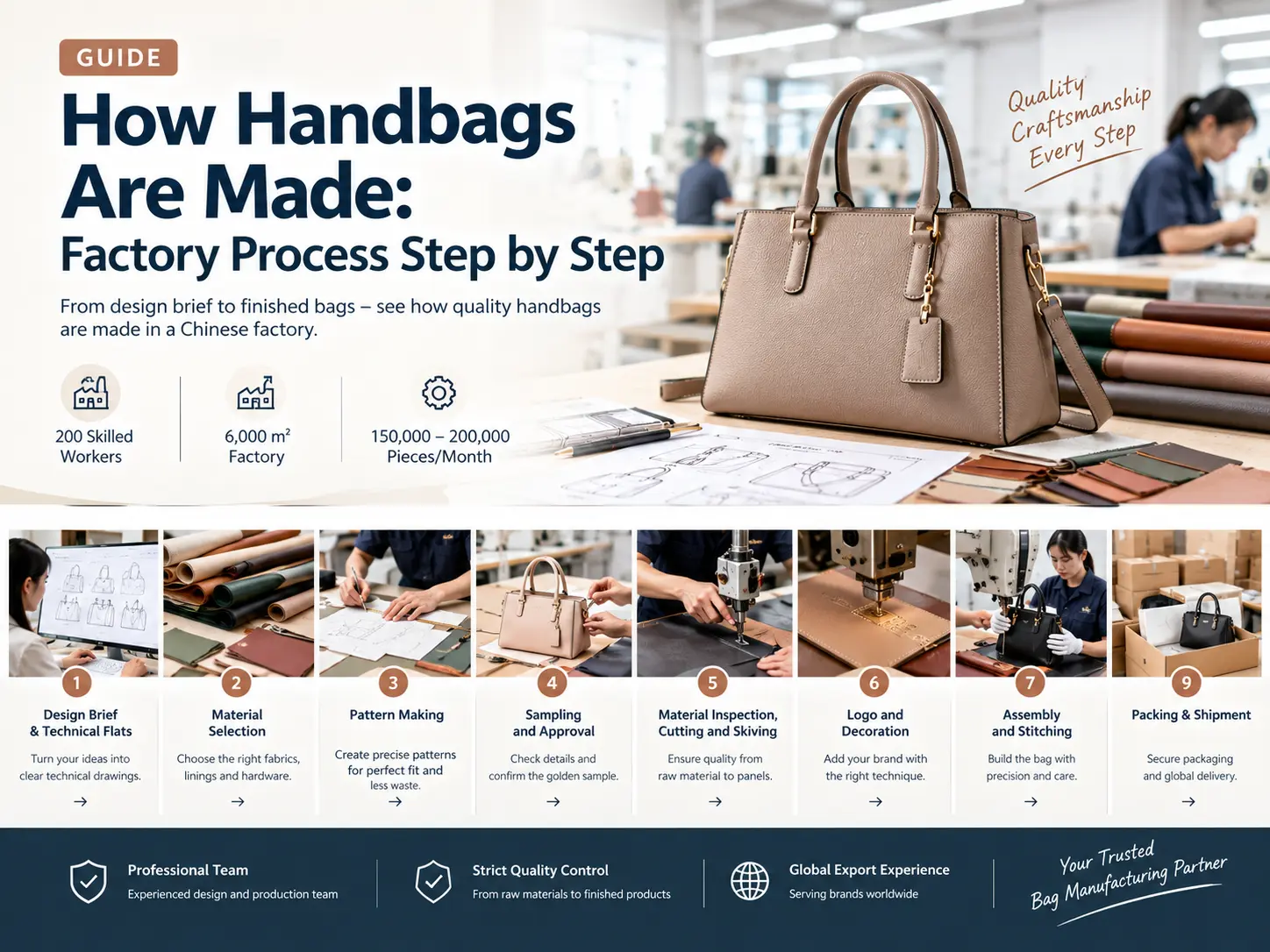
A direct bag factory owns or directly manages the people and processes making the bag. KEENOVA, for example, operates a 6,000 m² production site with 200 skilled workers. A trading company usually coordinates, buys from, or represents one or more factories.
A factory usually gives you a shorter route to development, materials, production, and QC. A trading company may have access to more suppliers or help coordinate several categories. The company label matters less than the working arrangement. Who answers a construction question? Who can correct a line issue? Who takes charge if export paperwork is incomplete?
| Comparison point | Direct bag factory | Trading company | What to verify |
| Production | Owns or directly manages the line | Coordinates with one or more factories | Which site makes this exact bag? |
| Technical feedback | Often direct to development/production | May relay feedback | Who confirms materials and construction? |
| Supplier range | Usually focused on its own capability | May combine several suppliers | Is multi-factory coverage useful for this order? |
| Quote path | Can quote production directly | May add coordination or sourcing scope | What is included, excluded, and owned? |
| QC | May control its own checkpoints | May coordinate factory or third-party checks | Who can stop, rework, and release goods? |
| Export support | Varies by manufacturer | Often part of the service | Who owns documents, booking, and Incoterm handoff? |
Some manufacturers also run their own export desk. That is a different arrangement from using a separate intermediary between the buyer and production. In either case, ask to see the actual factory, the people responsible for key decisions, the approved sample, and the QC plan.
2. When is a direct bag factory the better fit?
Direct factory access works best when an OEM or ODM bag needs repeated technical decisions.
Start with the product. A structured shoulder bag, a soft tote, a backpack, and a cosmetic pouch all create different questions about panels, reinforcements, linings, zippers, edge finishing, and hardware. If you need frequent decisions on those details, direct access to the team making the bag can shorten the feedback path and make responsibility clearer.
Direct access helps with reorders, too. The factory can connect the approved sample, materials, measurements, and QC requirements to the production reference. That matters when you need consistency across colors or future seasons. A production-floor photo is not enough, though. Ask for recent work that resembles your construction and materials.
Production access only helps when the factory fits the category
Request evidence that matches the bag you are buying: a relevant sample, a recent view of the sample room or line, and a direct conversation with a development, production, or QC contact. For a travel bag, ask about webbing, load points, zippers, and reinforcements. For a fashion handbag, ask about silhouette control, edge finishing, lining, logo placement, and hardware attachment.
Production-review prompt: Ask the supplier to restate the bag in its own words: dimensions, material, lining, colors, hardware, logo, packaging, quantity per color, and target market. This simple check exposes missing details before they turn into a sample revision.
3. When can a trading company be the better fit?
A trading company can be a sensible choice when its supplier coverage or coordination solves a real buying problem. That may include sourcing several product categories, combining multiple factories, managing a mixed trial program, or coordinating language, inspection, and export steps the buyer does not want to run alone.
The benefit has to be specific. “We work with many factories” is not enough. Ask which factory makes your exact bag, whether subcontracting is involved, who gives sample feedback, and who has authority to approve a quality correction. A useful trading company should make those answers easier to obtain, not harder.
Trading companies can help when you need a broader category mix than one specialist factory makes. But every extra party creates another point where information can drift. Confirm who owns the quote, technical interpretation, sample record, QC release, and shipping instruction. Vague responsibility makes problems slower to fix.
Questions that make a trading company accountable
Put four questions in writing: Who makes this bag? Who confirms the approved sample? Who deals with a QC issue? Who handles export documents and shipment?
Use a role map alongside the company label. List the owner of the quote, development feedback, material booking, line schedule, QC, export documents, shipment booking, and corrective action.
4. How do price, MOQ, and lead time really differ?
Price, MOQ, and lead time only mean something when suppliers quote the same bag.
A direct production path can remove a separate trading layer. It does not guarantee the lowest total cost. One quote may include a better lining, custom hardware, final inspection, retail packaging, or a different Incoterm. Another may leave those details open. The lower unit price can then be the less complete offer.
| Quote field | Question to normalize before comparing |
| Specification | Are dimensions, construction, materials, lining, colors, and tolerances the same? |
| Branding | Does the price include the same logo method, placement, and artwork work? |
| Components | Are hardware, zippers, reinforcements, and custom molds equal? |
| MOQ basis | Is the minimum by style, color, material, component, or total order? |
| Sampling/tooling | Are charges, credits, revisions, and molds shown separately? |
| Packaging/QC | What per-bag packing, carton marks, inspection, and evidence are included? |
| Payment/freight | What milestones, Incoterm, freight scope, and exclusions apply? |
Ask what a lead-time number includes
KEENOVA typically plans confirmed bulk orders for 30–60 days. A workable schedule also names design approval, sample revisions, material booking, production, packing, inspection, export documents, booking, transit, and destination handling. Ask which buyer decision protects the next date.
5. Who controls sampling, quality, and corrective action?
Look for staged quality checks and a named owner for each correction.
Quality control starts before production. The buyer and supplier should agree on the reference sample, measurements, materials, color standard, stitching, logo position, hardware function, lining, packaging, carton marks, defect definitions, and release authority. A final inspection alone is too late to prevent every costly issue.
| Stage | Buyer should confirm | Decision if the result differs |
| Materials | Color, finish, quantity, and agreed specification | Hold, replace, or approve material |
| Pre-production reference | Construction, measurements, branding, components | Approve, revise, or stop bulk release |
| Production line | Assembly, stitching, measurements, function | Correct the line before defects multiply |
| Packaging | Labels, protection, cartons, and marks | Correct packing before final release |
| Final inspection | Agreed sample plan and acceptance requirements | Release, rework, or resolve exceptions |

Agree the acceptance plan before production
If the order uses AQL or another sampling approach, record the inspection method, sample size, defect classifications, acceptance criteria, and decision owner in the purchase order or QC plan. A generic standard name is not enough. The purchase order needs to state the plan for this bag.
6. How can you verify if a bag supplier is the actual manufacturer?
Verify a bag supplier through current, category-relevant evidence that follows your product from the sample room to the QC plan. Those facts are useful only when a buyer can connect them to the actual bag, materials, and order being discussed.
Start with a current factory address and legal entity. Then request a live video call or recent dated walkthrough of the relevant sample room and production area. Ask to see comparable construction, materials, hardware, and the team who will turn your reference image into a sample.
Use these seven verification checks
- Confirm the factory address and legal entity. Check that the commercial counterparty and production site are clearly explained.
- Request a current walkthrough. Ask to see the relevant sample room and line, rather than a generic tour.
- Match proof to your bag. Compare panels, material, lining, hardware, stitching, and load points to your brief.
- Speak with a technical owner. A development, production, or QC contact should explain the practical questions behind the quote.
- Read the written quote assumptions. Check the MOQ basis, inclusions, exclusions, and open decisions.
- Approve a physical sample and dated revision record. Identify the sample that becomes the production reference.
- Confirm the QC and export plan. Name who handles corrections, documents, booking, and shipment release.
7. What does an integrated factory-and-export team change for a buyer?
An integrated manufacturer/exporter can give you direct production access and export coordination in the same company. KEENOVA was established in 2011, has 15 years of bag R&D and production experience, and develops 200+ new styles each month.
For a buyer, that can mean one accountable team handles the quotation, sampling feedback, production coordination, QC evidence, export paperwork, and shipment coordination. It does not mean every style has the same price, MOQ, lead time, or compliance path. Those need order-specific confirmation.
The benefit is practical: fewer people relaying the same question. If a reference image leaves the material, hardware, or construction open, the buyer can bring development, production, and QC into the same conversation instead of asking a separate trader to pass messages along.
Ask for the role map before you place an order
Write down who owns the quote, development feedback, material purchasing, line scheduling, QC, export documents, shipment booking, and corrective action. If that person changes during the order, update the record.
Judge an integrated model by who can make each decision, not by the number of services on its website. If the company can name the sample owner, line owner, QC owner, and export owner, you know where to send a question before it turns into a delay.
8. Which supplier should you choose for your next bag program?
Choose the supplier model that gives your actual bag program the needed capability and control. KEENOVA’s approved starting MOQ is 300 pieces per color, which shows why order structure matters: a clear style, color plan, material choice, and delivery market tell you more than a generic “factory versus trader” verdict.
Choose a direct factory first when you have a defined custom bag, repeat-volume potential, category-specific technical needs, and a reason to see development and QC more closely. Consider a trading company when its verified multi-factory coverage or coordination role solves a real sourcing need. Consider an integrated factory/export team when you want direct production access and export coordination in the same accountable company.
Before choosing, compare the evidence. Do you know which factory makes the bag? Are suppliers pricing the same specification? Is the sample reference controlled? Can the supplier explain QC and export responsibilities? If any answer is vague, get it settled before making a larger payment.
Frequently asked questions
Is a factory always cheaper than a trading company for bags?
No. A direct production path can remove a separate layer, but total cost still depends on the specification, materials, hardware, MOQ, tooling, packaging, QC, payment, and freight scope.
How can I tell if a China bag supplier is a factory?
Request a current factory address, a live or dated walkthrough of the relevant area, category-specific sample evidence, and a discussion with development, production, or QC.
Can a bag factory handle export documents and shipping?
Some factories handle export work through their own team or an established process. Confirm who prepares documents, manages booking, and owns the Incoterm handoff. KEENOVA operates a factory and export desk within the same company, but document and shipment scope must still be confirmed for each order and destination.
Choose proof before you choose a quote
A quoted price only matters after confirming your bag brief, supplier assumptions, QC plan, and shipment terms. Backed by 15 years of R&D and a BSCI-certified facility, KEENOVA helps fashion brands and wholesalers turn bag concepts into market-ready OEM/ODM collections.
Contact and share your reference image, target quantity, material preferences, and delivery market. We will review the practical next step with you.

Ivy is a custom bag specialist at Keenova, an integrated manufacturer and exporter of custom bags in China. She shares practical knowledge on bag design, material selection, and OEM/ODM manufacturing processes. She helps global brands, retailers, and wholesalers understand bag structures and choose the right factory solutions.