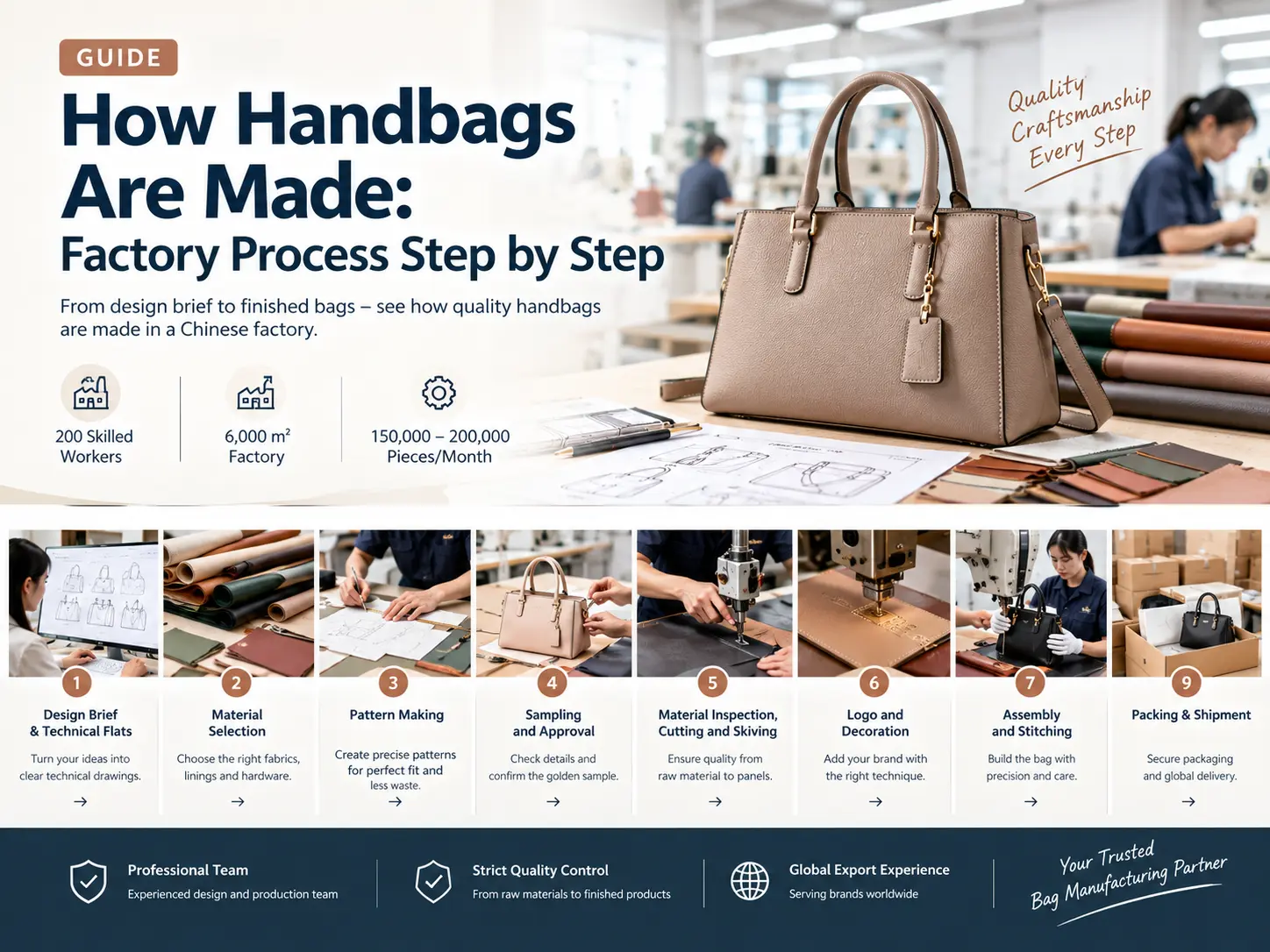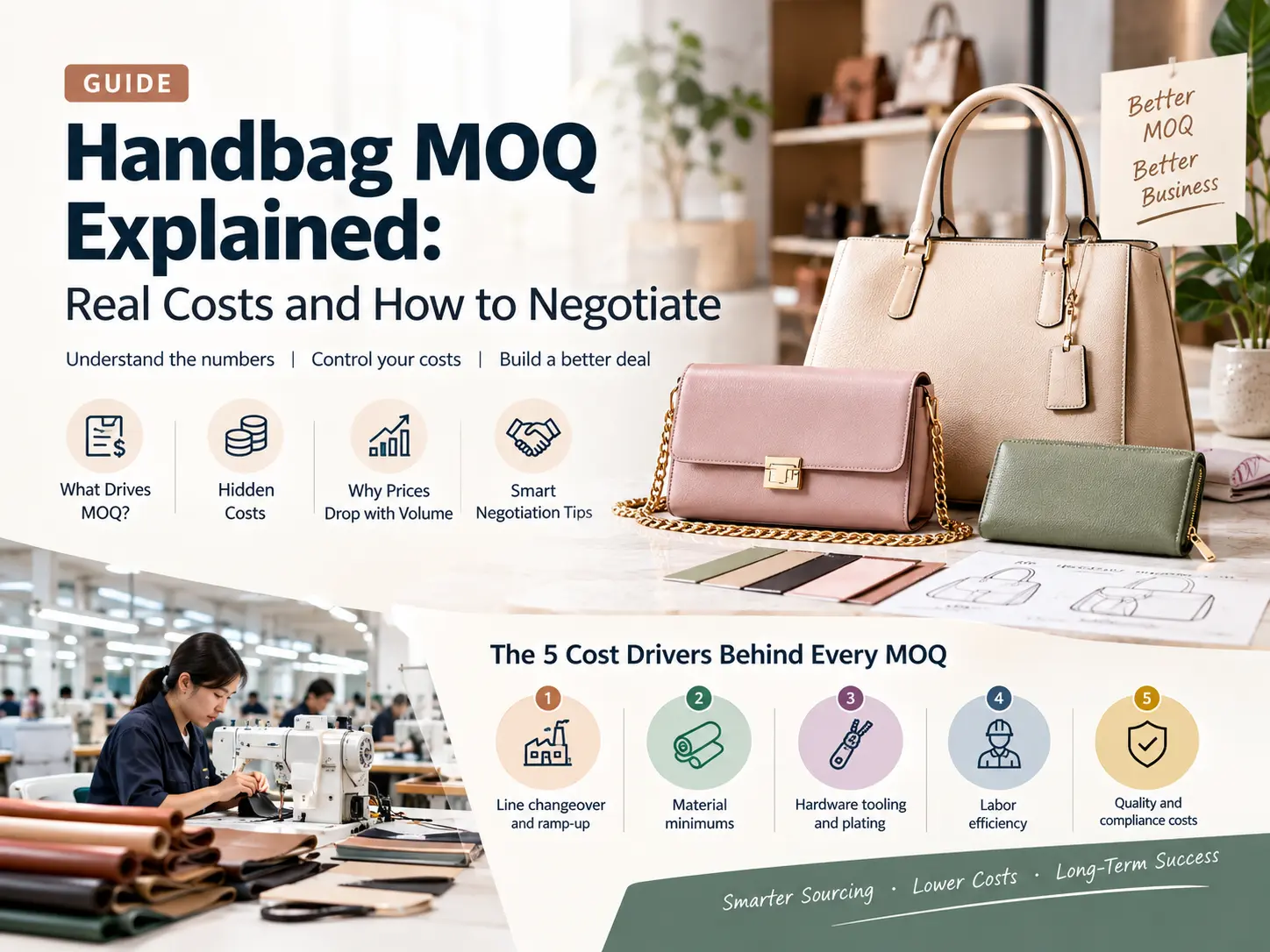
Crossbody bags have become one of the most stable categories in the global bag market. They sit at the intersection of fashion and function; they work across women’s, men’s, travel and tech ranges, and they are compact enough to keep development costs and minimum order quantities within reach for growing brands. For buyers planning a 2026 collection, the difficulty is rarely finding a factory. The difficulty is finding a crossbody bag manufacturer that can hold shape, strap comfort, hardware quality and colour consistency across repeat orders.
All details were reviewed against publicly available information in November 2026. Capacity, minimums and certifications change over time, so use this as a shortlist for evaluation rather than a final buying decision, and confirm current specifications directly with each supplier.
How We Selected These Crossbody Bag Manufacturers
The companies below were chosen on practical sourcing criteria rather than brand fame.
- Demonstrated bag manufacturing capability, with crossbody, shoulder, sling or messenger formats inside the product range
- OEM, ODM or private label service available to outside brands, wholesalers and importers
- Publicly available company information covering location, history and factory setup
- Export experience, including sampling, documentation and shipment support for overseas buyers
- Geographic spread so buyers can compare tariff, lead time and positioning trade offs
The order is not a quality ranking. A factory that suits a 300 piece launch will not suit a 300,000 piece program, and the right partner depends on your order size, material, price point and quality standard.
Quick Comparison: 10 Crossbody Bag Manufacturers at a Glance
| No. | Manufacturer | Headquarters | Establishment | Main Products | Best For |
|---|---|---|---|---|---|
| 1 | Sitoy Group Holdings | Hong Kong, China | 1968 | Luxury handbags, small leather goods, travel goods, footwear | Large premium programs |
| 2 | Youngone Corporation | Seoul, South Korea | 1974 | Outdoor and performance bags, apparel, footwear | High volume technical bag programs |
| 3 | Mherder (Guangzhou Herder Leather Products) | Guangzhou, China | 2006 | Leather handbags, crossbody bags, wallets, small leather goods | Lower minimums and broad customisation |
| 4 | HerminFashion | Huadu, Guangzhou, China | 2011 | Women’s fashion handbags, totes, crossbody bags, backpacks | Fashion led seasonal collections |
| 5 | Fiedle | Guangzhou, China | 2002 | Genuine leather handbags, totes, crossbody bags, hobo bags | Leather focused mid to high volume programs |
| 6 | Hidesign | Puducherry, India | 1978 | Vegetable tanned leather bags, crossbody bags, accessories | Artisan leather with a sustainability story |
| 7 | Furla | Bologna, Italy | 1927 | Leather handbags, crossbody bags, small leather goods | Italian made provenance and in house production |
| 8 | Yoshida and Co. (PORTER) | Tokyo, Japan | 1935 | Nylon and leather bags, crossbody and sling bags, backpacks | Japan made construction and material innovation |
| 9 | Senrong Bag (Senda Vietnam) | Nam Dinh and Ninh Binh, Vietnam | 2004 | Backpacks, fabric and functional bags, OEM programs | Volume shifting to Vietnam for tariff and capacity |
| 10 | Tom Bihn | Seattle, United States | 1972 | Travel bags, crossbody bags, backpacks, organisers | Small batch United States manufacturing |
1. Sitoy Group Holdings Limited
Company Profile:
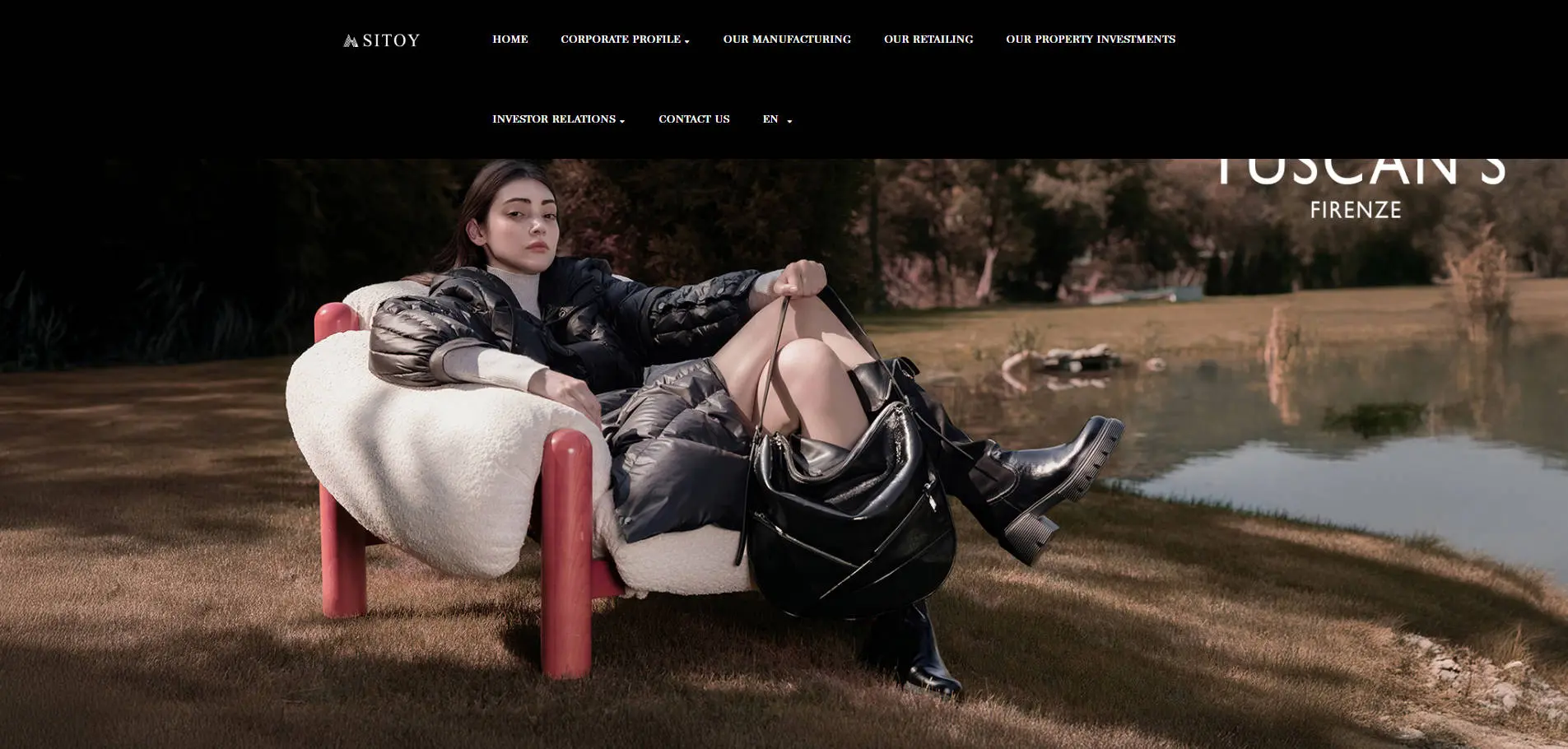
Sitoy Group Holdings is one of the world’s leading manufacturers of high end and luxury handbags, small leather goods, travel goods and footwear, and it also operates as a brand distributor in Greater China. The group’s manufacturing history runs from its first Hong Kong facility in 1968 to mainland plants in Shenzhen in 1982, Dongguan in 1992 and Yingde in 2009, with a new facility in Semarang, Indonesia announced for 2025. It was listed on the Hong Kong Stock Exchange in 2011 and has since built a retail and distribution arm alongside manufacturing, including owned brands Tuscan’s, Fashion and Joy and Duffy, and the 2018 acquisition of the Italian luxury house a.testoni.
For bag buyers, Sitoy represents the systems end of the market. The group began manufacturing handbags for American luxury brands in 1998 and for European luxury brands in 2003, and that history shows up in how it handles structured shapes, edge finishing, hardware setting and leather selection. Crossbody and shoulder formats sit inside broader brand programs rather than being a standalone line, which suits buyers running full collections at scale. Its vertically integrated model covers design, research, development, manufacturing, wholesale and retail, and its multi-country footprint supports capacity planning and origin diversification. As a listed company, it also publishes audited results and governance disclosures, giving buyers a level of transparency that privately held factories rarely match.
Establishment: 1968
Headquarters: Hong Kong, China
Main Products:
- Crossbody bags and shoulder bags developed inside luxury brand programs
- Structured leather handbags and top handle bags
- Small leather goods, including wallets, card holders and pouches
- Travel goods and business bags
- Footwear produced under brand manufacturing programs
2. Youngone Corporation
Company Profile:
Youngone Corporation is a South Korean manufacturer founded in 1974 and headquartered in Seoul. It grew out of the outdoor and down outerwear trade and now supplies technical apparel, footwear, bags, camping gear and specialty nylon and polyester materials to global brands including Nike, The North Face, Patagonia, Lands’ End and L.L.Bean. Youngone Corporation was listed on the Korea Exchange in 2009 after being spun off from Youngone Holdings, and it operates production facilities across Bangladesh, Vietnam, China, El Salvador, Uzbekistan, Ethiopia and India. Industry reports describe annual revenue in the region of US$3 billion with a global workforce in the tens of thousands.
Where bags are concerned, Youngone’s advantage is technical production at scale. Its OEM business covers backpacks, duffels, sling and crossbody formats built for outdoor and performance use, and the group’s vertical integration reaches back into fabric, fill, seam sealing and finishing rather than stopping at cut and sew. For brands, that means a crossbody program can be specified with the same material discipline as a technical shell, and it can be shifted between origins as tariff or capacity conditions change. Youngone also works under the compliance and testing regimes of the largest outdoor brands in the world, which is a useful signal for buyers who need restricted substance testing, social compliance audits and consistent repeat production across seasons.
Establishment: 1974
Headquarters: Seoul, South Korea
Main Products:
- Crossbody bags and sling bags for outdoor and performance programs
- Technical backpacks and daypacks
- Duffel bags, travel bags and camping gear
- Specialty nylon and polyester materials developed for bag shells
- Technical outdoor apparel and footwear
3. Mherder

Company Profile:
Mherder has manufactured leather bags and small leather goods in Guangzhou since 2006 and markets its OEM and ODM services to brands, wholesalers, importers, ecommerce sellers and corporate gifting programs. The catalogue covers handbags, shoulder bags, crossbody bags, men’s bags, backpacks, wallets and card holders, produced in genuine leather, PU, PVC, canvas and nylon. The company reports more than nineteen years of leather goods manufacturing experience, multiple production lines, structured sampling and bulk quality control.
For a crossbody project, Mherder is one of the more accessible entry points in China. Development can start from a sketch, a tech pack, a reference photo, a physical sample or an existing style, and customisation extends to leather grade, lining, edge paint, closures, logo method, custom hardware, straps, dust bags, boxes, hangtags and retail packaging. Reported minimums start from around 100 pieces per style per colour for fully customised leather bags, while selected ready made styles with laser logo application support smaller trial orders, which is practical for testing a crossbody silhouette before committing to volume. The factory also supports coordinated sets, so a crossbody can be developed alongside a matching wallet or card holder, with shared colour standards checked across leather, lining, thread and painted edges.
Establishment: 2006
Headquarters: Guangzhou, Guangdong, China
Main Products:
- Leather crossbody bags and shoulder bags
- Women’s handbags, tote bags and hobo bags
- Men’s bags and business bags
- Wallets, card holders and small leather goods
- Backpacks and travel bags
4. HerminFashion
Company Profile:
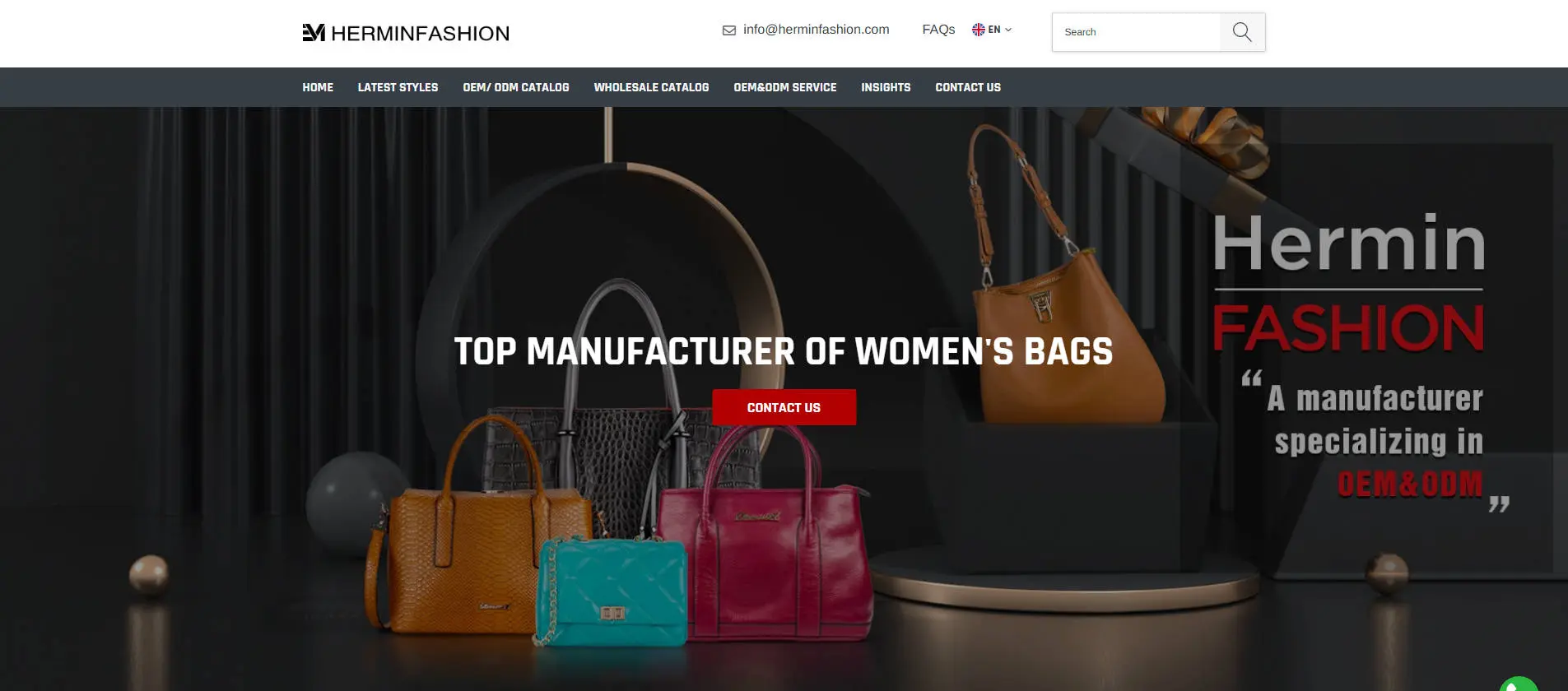
HerminFashion operates in Huadu District, Guangzhou, and concentrates on women’s fashion handbags. Its published manufacturing history begins in 2011 and the current company entity was established in 2018. The factory reports a facility of roughly 4,000 square metres with six production lines and monthly capacity above 75,000 bags, and its range spans handbags, tote bags, shoulder bags, crossbody bags, hobo bags, bucket bags, backpacks, evening bags and vegan PU styles.
The value for crossbody buyers is development speed and coordination. A custom project usually has to resolve several variables at the same time, including structure and dimensions, outer material and lining, colour development, logo application, metal hardware, zippers and closures, straps, reinforcement and packaging, and HerminFashion positions its service around handling all of them under one roof. Standard production MOQ is stated at 300 pieces per style with at least 100 pieces per colour, which suits brands testing a few colours in one drop. Its PU and vegan leather capability is a further advantage for buyers whose crossbody line needs lower price points, easier colour consistency or a synthetic material story, and the factory’s fashion led sampling cycle fits brands that refresh styles every season rather than running one silhouette for years.
Establishment: Manufacturing history from 2011, current entity established in 2018
Headquarters: Huadu District, Guangzhou, Guangdong, China
Main Products:
- Women’s crossbody bags and shoulder bags
- Tote bags and hobo bags
- Bucket bags and evening bags
- Backpacks
- Vegan PU handbags and purses
5. Fiedle

Company Profile:
Fiedle is a Guangzhou based OEM and ODM leather bag manufacturer established in 2002. Its range covers genuine leather handbags, tote bags, crossbody bags, hobo bags and other fashion led styles, and the company publicly discloses a production facility of around 20,000 square metres in Guangzhou. With more than two decades of continuous operation, it sits in a useful middle ground between the small flexible workshops that dominate the low end of the market and the very large listed groups that set high minimums.
Fiedle’s advantage in bags is its leather first orientation. Crossbody styles in genuine leather place specific demands on a factory: cutting yield and hide selection determine how a panel sits, edge painting determines whether the bag looks finished or home made, and reinforcement at the strap anchors determines whether the bag survives daily load. A manufacturer that works in leather every day handles those variables differently from one that treats leather as an occasional material alongside synthetics. Fiedle’s Guangzhou location also keeps it inside the local leather goods supply chain, where material merchants, hardware workshops, pattern makers and packaging suppliers are close enough to resolve a hardware plating change or a substitution quickly during development.
Establishment: 2002
Headquarters: Guangzhou, Guangdong, China
Main Products:
- Genuine leather crossbody bags
- Shoulder bags and tote bags
- Hobo bags and slouchy leather styles
- Structured leather handbags
- Custom developed fashion leather styles
6. Hidesign

Company Profile:
Hidesign was founded in 1978 in Puducherry, India, by Dilip Kapur and has grown into one of India’s best-known leather goods houses. The company is built on full-grain, vegetable-tanned leather produced with traditional South Indian tanning methods, solid brass fittings and hand-finished construction, and it reports around 90 stores across 24 countries, including the United States, the United Kingdom, Australia, Russia, the United Arab Emirates and Kenya. Hidesign is also notable for its workforce: company materials state that around 90 percent of its artisans are women, recruited from local villages and trained in-house.
For crossbody bags, the material story is the selling point. Hidesign continues to use slow, labour-intensive vegetable tanning with natural seeds and bark from South India rather than the faster chrome processes most tanneries adopted, and it applies no PU or synthetic coating, so the leather softens and darkens with use instead of flaking. Its brass hardware is sand cast and hand polished, which gives even a small crossbody a recognisable detail at the closure and strap anchors. Buyers get a bag with a genuine craft and sustainability narrative behind it, backed by finishing standards proven across two dozen export markets, and a vegetable tanned crossbody reads as a different product from a corrected grain alternative at the same price.
Establishment: 1978
Headquarters: Puducherry (Pondicherry), India
Main Products:
- Vegetable tanned leather crossbody bags
- Shoulder bags and handbags
- Wallets and card holders
- Belts and watch cases
- Small leather accessories
7. Furla

Company Profile:
Furla is an Italian leather goods house founded in 1927 and headquartered in Bologna, operating in the accessible luxury segment between mass market and heritage houses. Unlike many brands in its price range, it invests directly in production. Its Progetto Italia complex in Tavarnelle Val di Pesa, in the Chianti area of Tuscany, opened in 2021 after a reported investment of 30 million euros and roughly three years of construction. The site covers around 464,000 square feet with three main buildings for offices, production and logistics, and it also hosts the Furla Academy, which trains craftspeople in Furla’s own methods.
That in house capacity matters to anyone studying how a crossbody bag should be made at the premium end. Furla treats crossbody as a core category rather than a seasonal afterthought, with dedicated crossbody lines released alongside its handbag and mini bag ranges each season, and it controls the process from leather selection through cutting, assembly and finishing inside its own Tuscan facility. Italian manufacturing supports clear country of origin claims, which in turn supports premium pricing, and the local Tuscan leather supply chain shortens the distance between a material decision and a finished sample. For buyers, Furla is a reference point for what vertical integration looks like in practice: higher cost, tighter control, and a product story that can be told with specifics.
Establishment: 1927
Headquarters: Bologna, Italy
Main Products:
- Leather crossbody bags
- Mini bags and small crossbody styles
- Handbags and top handle bags
- Small leather goods, including wallets and card holders
- Leather accessories
8. Yoshida and Co., Ltd.
Company Profile:
Yoshida and Co., widely known as Yoshida Kaban, was founded in Tokyo in 1935 by Kichizo Yoshida and remains a family managed manufacturer. The company built its reputation on the idea that a bag should be a tool for carrying things, and it launched the PORTER label in 1962, named after the hotel porters whose work ethic inspired it. The Tanker series arrived in 1983 and became its signature line, followed by Luggage Label in 1984 and Porter Girl in 2009. Yoshida has also collaborated with brands and technology companies ranging from Nike and Stüssy to Sony and Apple.
Crossbody and sling bags are where Yoshida’s approach is easiest to appreciate. The PORTER Tanker Sling Bag is one of the clearest references in the category: a three-layer construction of nylon twill shell, padded interlining and contrast orange lining that stays featherlight while holding a soft structure. Every stage from fabric development to final assembly is handled in-house in Japan, including the company’s own factory, which is increasingly rare in a category where most production has moved offshore. Hardware and zips are specified to the same standard as the fabric, and the company has a track record of introducing new materials into bags, from Gore-Tex to its own Tanker fibre. For buyers, the lesson is that a small crossbody is a materials problem before it is a styling problem.
Establishment: 1935
Headquarters: Higashi-Kanda, Chiyoda, Tokyo, Japan
Main Products:
- PORTER crossbody bags and sling bags, including the Tanker and Force series
- Shoulder bags
- Backpacks and daypacks
- Wallets, pouches and small accessories
- Travel bags and duffels under the Luggage Label line
9. Senrong Bag
Company Profile:
Senrong Bag operates across the China and Vietnam manufacturing map. The group reports a founding year of 2004 and a base in Nam Dinh Province in Vietnam alongside its Guangzhou operations. Its Vietnamese footprint includes Senda Vietnam in Ninh Binh with more than 1,000 employees, 18 production lines and roughly 10,000 square metres, plus Sen Bang Vietnam, opened in 2024 with five production lines. Public sourcing guides describe group capacity in the millions of units per month across fabric bags and backpacks.
The reason buyers look at Senrong in 2026 is origin strategy. Vietnam has signed more than fifteen free trade agreements, and bag and accessory exports have grown steadily, with trade data putting the sector in the multibillion dollar range and Vietnamese daypack shipments ahead of both China and Indonesia over recent twelve month windows. Public sourcing guides cite US import duties on Vietnamese bags at roughly 17 percent compared with about 42.5 percent on Chinese origin, alongside EVFTA and CPTPP preferences, and those numbers change the landed cost calculation on a high volume crossbody program. Senrong’s dual footprint also lets a brand keep sourcing PU, nylon and hardware through Chinese supply chains while cutting and finishing in Vietnam, which is the combination many mid market brands are now standardising on.
Establishment: 2004
Headquarters: Nam Dinh Province, Vietnam, with manufacturing in Ninh Binh and a presence in Guangzhou, China
Main Products:
- OEM and ODM sewn bag programs, including sling and crossbody formats
- Backpacks and daypacks
- Cosmetic bags and toiletry bags
- Travel organisers and packing cubes
- Sports bags and shopping bags
10. Tom Bihn

Company Profile:
Tom Bihn has been designing and making bags since 1972 and became an official company in 1982, beginning as a one person workshop in Santa Cruz, California, before moving to Seattle in 2005. Today its headquarters and factory sit together at Ohio Avenue South in Seattle, with a factory showroom and a retail store, and production is handled both in Seattle and through a long standing partner in Vietnam. The catalogue covers travel bags, backpacks, organisers and crossbody styles, and the company develops its own fabrics and reports operational carbon neutrality since 2018.
For crossbody buyers, Tom Bihn is the clearest example of what small batch domestic manufacturing buys you. Design, production engineering, cutting, sewing and quality control all happen in one building, so a strap length change or a pocket layout revision can be resolved on the floor rather than through a week of emails across time zones. Crossbody and messenger styles such as the Side Effect show the company’s priorities: internal organisation that separates essentials, weather resistant materials, reinforced seams and a padded adjustable strap designed to sit correctly across the body. The trade off is cost and capacity, since United States production carries higher labour costs and smaller runs, but the return is direct factory accountability, repair friendly construction and long term parts support.
Establishment: 1972, incorporated in 1982
Headquarters: Seattle, Washington, United States, with additional production through a Vietnam partner
Main Products:
- Crossbody bags and messenger bags
- Travel bags and backpacks
- Tote bags
- Organisers and pouches
- Travel accessories
How to Choose the Right Crossbody Bag Manufacturer
Crossbody bags look simple and are surprisingly easy to get wrong. Strap drop, load balance, zip runs, gusset construction and reinforcement at stress points all determine whether a bag feels right after a week of use. Use the criteria below to compare factories before you commit sampling budget.
| Criterion | What to Ask | Why It Matters |
|---|---|---|
| Category experience | Show me crossbody or sling styles you produced in the last 12 months | A tote specialist often underestimates strap engineering and small format hardware |
| Material capability | Which materials do you cut and sew in house | Genuine leather, PU, coated nylon and canvas need different equipment and skills |
| Minimum order quantity | What is the MOQ per style and per colour | Determines whether you can test several colours without over committing |
| Sampling | How many rounds are included and what does each revision cost | Sample accuracy predicts bulk accuracy |
| Hardware and closures | Do you source custom hardware and test zip cycles | Hardware failure is the most common source of returns in this category |
| Colour control | How do you match leather, lining, thread and edge paint | Mixed materials rarely take colour the same way |
| Compliance | Which standards and test reports can you provide | Retail and marketplace requirements vary by market |
| Capacity planning | What is your realistic monthly capacity for my style | Prevents a second season slipping because you were deprioritised |
OEM, ODM and Private Label: What Each Model Means for Your Crossbody Line
OEM means the factory builds your design. You supply the tech pack, material specification or reference sample and the factory reproduces it in bulk. This model suits brands with design capability and protects differentiation.
ODM means the factory already has a base pattern and you adapt it. You change material, colour, hardware, lining, logo and packaging on top of an existing shape. This model reduces development time and cost and suits buyers testing a category.
Private label sits between the two. You take an existing or lightly modified style and sell it under your own brand with your own labelling and packaging. It is the fastest route to market and the easiest way to test price points before funding full development.
Most crossbody programs start with ODM or private label, then move to OEM once a silhouette proves itself.
Questions to Ask Before You Pay for Samples
- Are you a factory, a trading company, or both, and where will my order actually be produced?
- What is the MOQ for my material, hardware and packaging combination, in writing?
- How many sample rounds are included, and what happens if the fit or shape needs a third revision?
- Can you show recent production for a crossbody bag with a similar strap and closure?
- Which compliance and test reports can you provide for my target market?
- Who is responsible for inspection, and can I see in process photos during production?
- What is your realistic lead time in peak season, not in the slow season?
Frequently Asked Questions
What is a typical MOQ for custom crossbody bags?
Minimums vary by material and construction. Leather focused factories commonly quote from 100 pieces per style per colour, while fashion factories working with PU and synthetic materials often start around 300 pieces per style with 100 pieces per colour. Custom hardware, custom colours and retail packaging can raise the figure.
How long does crossbody bag development take?
Sampling commonly runs one to three weeks per round depending on pattern complexity and hardware sourcing. Bulk production usually follows 25 to 45 days after sample approval, and peak season capacity can extend that window.
Which country is best for manufacturing crossbody bags?
It depends on your priority. China offers the widest material and hardware choice with the lowest development friction. Vietnam offers tariff advantages on several key markets and large sewn bag capacity. Italy and Japan offer provenance and finishing quality at higher cost. India offers artisan vegetable tanned leather. United States production suits small batch, high margin programs where domestic origin is part of the value proposition.
Should I choose leather or vegan materials for a crossbody line?
Genuine leather still reads as premium and ages well, but it needs stricter colour control and higher material costs. PU and vegan leather offer lower cost, easier colour consistency and simpler compliance, and quality has improved enough that many mid market brands build entire collections on synthetics. Decide based on your price point and how you want the bag to age.
Can small brands really develop their own crossbody bag?
Yes. Low minimum factories, ODM base patterns and private label programs make it possible to launch with a few hundred pieces. The key is to limit variables in the first run, choose stock hardware where possible, and confirm every specification in writing before sampling starts.
What certifications should I ask for?
Ask for ISO 9001 where applicable, social compliance audits such as BSCI or Sedex, and material testing relevant to your market, including REACH for the European Union, California Proposition 65 for the United States, and restricted substance testing for leather, coatings and hardware.
Final Thoughts
The crossbody category rewards factories that understand small format construction, and the ten manufacturers above represent very different answers to the same brief. Large groups such as Sitoy and Youngone bring scale, systems and multi origin capacity. Mid sized Chinese specialists such as Mherder, HerminFashion and Fiedle offer lower minimums and faster development cycles. Regional houses such as Hidesign, Furla, Yoshida and Tom Bihn show what dedicated in house production delivers when provenance is part of the product.
If you are planning a crossbody program for 2026, shortlist three to five factories from this list, send the same tech pack to each, and compare samples on strap comfort, shape retention, hardware feel and finishing consistency rather than price alone. The cheapest sample is rarely the cheapest program once repeat orders, returns and colour matching are taken into account. If you would prefer a partner that works on crossbody formats every day rather than seasonally, Keenova above runs a dedicated crossbody line with 7 to 10 day sampling, a 300 piece per colour minimum and 200 plus new styles every month, which is a practical place to start that conversation.

Zack is a custom bag specialist at Keenova, a leading integrated manufacturer and exporter of custom bags in China. With deep expertise in bag design, material selection, and OEM/ODM manufacturing processes, Zack helps global brands, retailers, and wholesalers navigate complex bag structures and find tailored, high-quality factory solutions.