Two supplier quotes can both say “genuine leather” and still describe different bags. One may use a corrected, coated surface with a strict color standard. Another may allow more natural variation and different panel selection. The gap reaches beyond the material line on the quote. It shows up in the sample, cutting plan, edge finish, QC standard, and the promise you make to your customer.
For a wholesale buyer, “Which leather grade is best?” is rarely the useful question. Ask instead: “What finished material and construction does this bag need at this price point, for this market?” That is the question a quote should answer.
Key Takeaways
- Leather “grades” are useful buying terms, but they do not define the finished bag. A quote should specify the material category, surface finish, thickness, color standard, backing, panel-selection rules, and approved reference sample.
- Full-grain, top-grain, corrected finishes, suede, split leather, and reconstituted materials can all fit different bag roles. The right choice depends on the target price, desired appearance, daily use, acceptable variation, and customer expectations.
- Do not compare unit prices until suppliers are quoting the same scope. Material selection, cutting yield, grain matching, reinforcement, lining, hardware, edge paint, packaging, MOQ, QC, and Incoterm can all change the real cost.
- Use a swatch and pre-production sample to turn subjective requests such as “soft,” “matte,” or “natural-looking” into an inspection standard. If the expectation cannot be shown in the approved sample or checked during QC, it is likely to create disagreement in bulk production.
- The safest sourcing approach is specification before grade: document the material and construction details first, then choose the option that fits the bag’s role and budget.

1. Are leather “grades” a reliable way to compare wholesale bags?
No. These labels are useful shorthand, but they cannot replace a finished material specification. Suppliers and buyer guides use terms such as full-grain and top-grain to start the conversation. The supplier still needs to explain what the proposed material actually is. A label does not set your color, thickness, coating, defect allowance, or acceptance standard.
Keep the categories separate. A hide layer tells you where the material came from. A finish tells you what happened to its surface. A trade label tells you how it is being sold. The approved swatch and sample tell the factory what it must reproduce. Mix those up, and the budget usually gets messy.
What does a grade label leave unspecified?
It can leave out the details that change both price and appearance: thickness range, color reference, gloss level, coating feel, backing, grain direction, permitted natural marks, and panel selection. Two factories can use the same leather name and still make visibly different bags. One may cut around scars. Another may allow them on less visible panels.
“Genuine leather” is especially broad. It may tell you that the item contains leather, but it does not give production enough to work from. Ask what it means in that quote. Is there a coating or backing? What is the thickness? Which swatch controls color? Get clear answers before you approve a sample.
The working rule is simple: specification before grade. Use grade words to open the supplier discussion, then turn them into visible or measurable approval points. That makes two offers easier to compare and stops an expensive-sounding phrase from doing all the work.
2. When does full-grain leather make commercial sense?
Full-grain leather can work for a higher-ticket bag where natural character is part of the appeal, provided the customer accepts variation and the budget covers the selection and construction work. Ask the supplier to describe the finished material, then show it in a swatch and sample. The grade is a starting point. It does not prove tanning quality, seam strength, hardware quality, or final inspection.
Natural character may suit a structured tote, a heritage satchel, or a travel bag. It also raises practical questions. How much grain variation is acceptable? Can a healed mark appear on a side gusset? Do front panels need to match? Must every unit look identical in color? Decide that before the cutting team starts.
Questions to settle before approval
Ask for a thickness range and tolerance. Confirm the finish, color reference, gloss, and hand feel. Decide where natural marks may appear and whether paired panels need visual matching. Then approve a swatch and a finished sample rather than relying on a material name in a quote.
Full-grain does not automatically make a bag last longer. Thin panels, weak reinforcement, poor edge paint, or unsuitable hardware can still shorten its working life. Match the material to the construction and use case. A crossbody carried every day takes stress in different places from a cosmetic pouch.
During sample review, put the swatch beside the finished bag. A product-development or QC reviewer can then spot color drift, coating feel, grain direction, edge treatment, and panel placement in one conversation. Reviewing each item alone makes those calls harder.
3. When is top-grain or corrected-grain leather the better budget choice?
Top-grain or corrected-and-finished leather may be the practical choice when a collection needs controlled color, visual consistency, and a defined target price. Confirm the process and finish with the supplier. “Top-grain” is used broadly in commercial descriptions.
For a core shoulder bag in several colors, a controlled finish can make matching, photography, and reorders easier. An embossed texture may also give the range a repeatable look. The buyer does not need to defend a label. The buyer needs to decide whether that surface fits what customers expect from the bag.
| Buyer question | Natural-character option | Controlled-finish option |
| Is visible variation welcome? | Often yes, if approved | Usually limited by the reference sample |
| Is strict color repeatability important? | Requires clear selection rules | Requires clear color and finish standards |
| What drives approval? | Grain character, panel placement, construction | Coating feel, emboss, color, construction |
| What should be quoted? | Selection rules and matching expectations | Finish description and color-control expectations |
Ask the supplier how the surface was prepared and finished. A more controlled appearance can be right for the job, but the finish needs checking on the actual sample. Look at the coating feel, scratch appearance, cleaning expectations, edge behavior, and what happens when the material flexes around corners.
Budget problems often start as consistency problems. A cheaper-looking material line can cost more later if the visual standard is vague and the finished order prompts arguments about color, grain, or coating. Put the standard into the swatch and pre-production reference before weighing the quote.
4. What should buyers know about split leather, suede, and bonded material?
Split leather, suede, and bonded or reconstituted material may fit particular bag applications, but the supplier needs to identify them clearly. They should never be swapped in without approval. In a quote, treat each as a material category that needs a supplier description, a visible swatch, and an approved sample. What matters is how the finished material behaves in the agreed bag application.
Do not judge these materials by appearance alone. Ask the supplier to state the category, visible surface, finish or coating, backing where used, thickness, edge treatment, and intended bag application. Put those details in the material description instead of hiding them behind a broad label.
Match the material to the bag role
A softer split or suede may work on a decorative panel or a seasonal fashion style if the buyer accepts the care needs. A backed material may suit a construction where the backing is disclosed and approved. For any option, agree abrasion expectations, edge behavior, reinforcement, labeling, and the sample that governs production.
Avoid blanket statements such as “bonded is bad” or “suede is fragile.” They do not help anyone write a purchase order. A buyer needs a named material, a defined use case, and a documented acceptance rule. The same material may suit one accessory and fail another.
5. Which budget factors change a leather bag quote beyond the leather grade?
Leather type is only one part of the quote.
Bag shape changes the cutting plan. A wide front panel may need more selective cutting than a small tab. A buyer who wants clean fronts, matched grain, and limited natural marks needs different rules from one who accepts more character on less visible areas. Both may use leather, but the usable yield and inspection work will differ.
Use a quote-normalization checklist
| Quote field | What the buyer should confirm |
| Material | Material category, hide/finish description, thickness range, backing |
| Appearance | Color reference, gloss, emboss, grain direction, allowed variation |
| Cutting | Panel-selection and matching rules; treatment of natural marks |
| Construction | Reinforcement, lining, edge paint, stitching, hardware, logo method |
| Commercial scope | MOQ per color, sample/tooling fees, packaging, payment, Incoterm, exclusions |
| Quality | Approved swatch, pre-production sample, inspection stages, corrective-action owner |
There is no useful universal percentage for the price gap between leather grades in wholesale bags. Origin, tannage, finish, thickness, bag shape, order size, panel rules, and current supply conditions all affect it. If a factory shares cost bands for one approved design, record the method and date range.
6. How should a buyer write a leather specification that a factory can quote?
A quote-ready leather brief gives the factory something it can sample and inspect. State the delivery market before sampling so the buyer can arrange a qualified review of relevant product safety, material, labeling, and chemical requirements.
Use this ten-field brief before requesting a final quote:
- Product and use case: tote, crossbody, wallet, travel bag, or another defined category.
- Material and finish: state the material category, surface, emboss, coating, and intended look.
- Thickness: request a target range and permitted tolerance where relevant.
- Color: provide a color reference and state the matching method.
- Panel placement: define grain or emboss direction and visible-panel priorities.
- Natural marks: state the acceptable defect or variation rule.
- Hand feel and sheen: add a reference swatch or visual benchmark.
- Supporting construction: specify backing, reinforcement, lining, and edge treatment.
- Market review: identify the delivery market and arrange the required qualified compliance or labeling review.
- Approval control: name the governing swatch, sample revision, inspection plan, and sign-off owner.
Turn adjectives into evidence
Words such as “soft,” “matte,” and “luxury” do not give production a pass/fail standard. Pair them with a swatch, a close-up reference, a target thickness where relevant, and an approved sample. If the bag must feel soft but hold its shape, specify the reinforcement and construction that make that happen.
State the destination market early. A factory can review the production path, but a general regulation link does not prove that a specific bag meets every requirement. Leave time for qualified product and labeling review, especially when material treatments, labels, packaging, or customer claims are involved.
7. How do samples and QC protect the material budget?
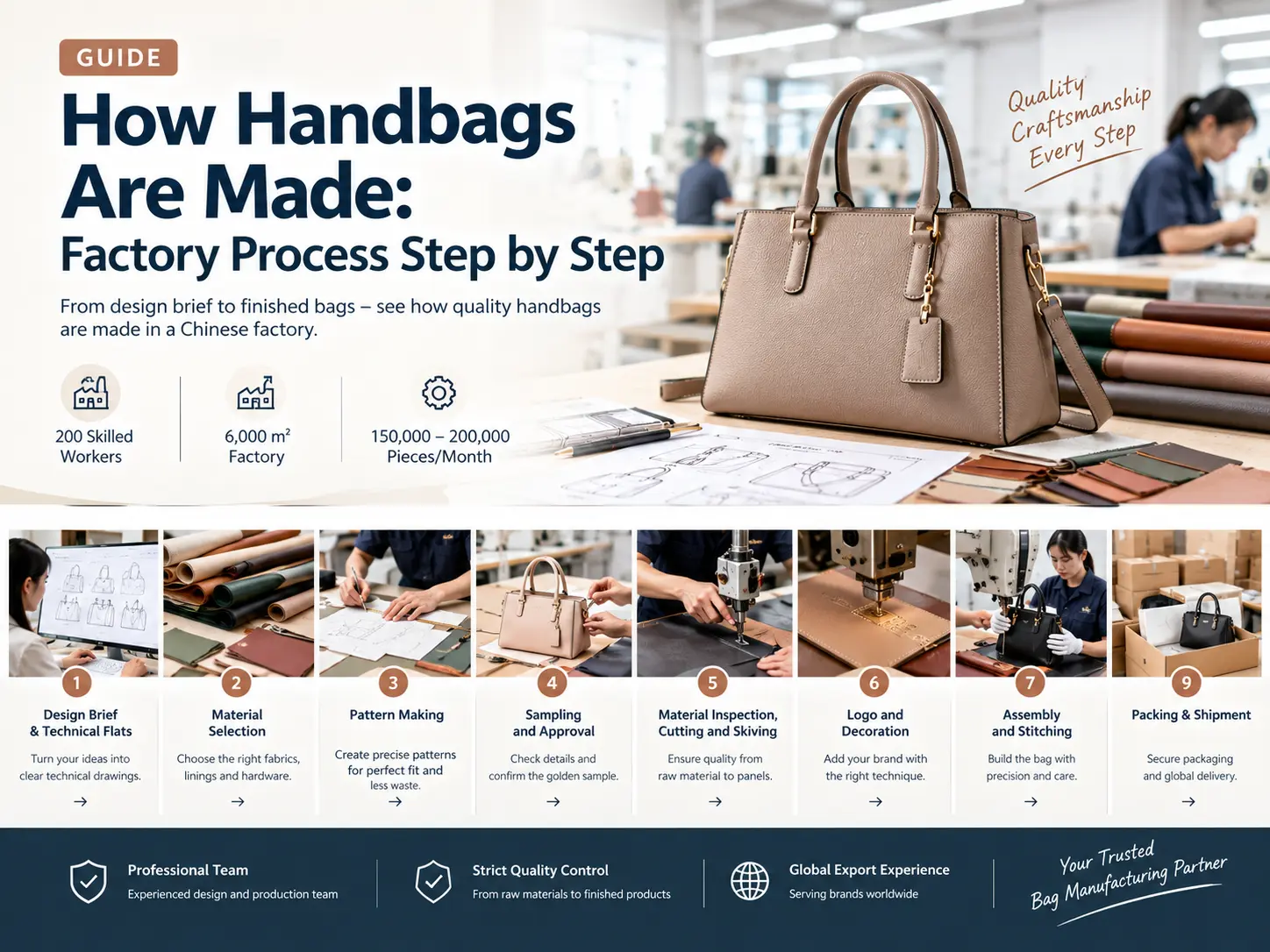
Approved swatches and pre-production samples give inspectors something concrete to check. KEENOVA’s independent QC team checks materials, pre-production samples, production lines, packaging, and final shipment inspection.
The order matters. Material approval sets the look and feel. The pre-production sample shows how that material works in the actual construction. Line checks show whether the approved treatment is being repeated. Packaging review helps protect the finished item in transit. Final inspection checks the agreed standard before shipment.
Agree the acceptance plan before bulk production
Put the sampling plan, natural-variation rule, escalation path, and sign-off authority in the purchase order. A sampling plan cannot choose your appearance standard or approve a bag on its own. The buyer and supplier need to document the criteria the inspector will use.
That agreement protects the budget by removing assumptions that were never priced. If a buyer wants no visible variation, precise panel matching, or a particular coating feel, the sample and inspection plan need to show how those expectations will be checked. If no one can inspect a requirement, it will be hard to manage during bulk production.
8. How should buyers choose a grade-and-budget strategy for each bag role?
Choose the grade-and-budget strategy that fits the bag’s role, the customer’s expectation, and the approved sample. A universal material hierarchy will not do that job.
| Bag role | Material direction to explore | Buyer risk to verify | Sample/QC checkpoint |
| Hero or heritage style | Natural-character leather where appropriate | Variation, panel match, edge detail | Front-panel and color approval |
| Core repeat style | Controlled finish with repeatable standards | Color, finish consistency, reorders | Swatch, pre-production sample, line check |
| Fashion or color-led style | Finish and color coordinated to the collection | Seasonal color match, components, quantity | Color standard and hardware review |
| Entry-price accessory | Clearly disclosed material and construction | Customer expectation, backing, edge behavior | Material disclosure and finished-sample approval |
For a hero tote, natural character may earn its place if the buyer accepts variation and pays for careful selection. A core crossbody may need repeatability more than character. A seasonal shoulder bag may live or die on color and finish. An entry-price accessory needs precise material disclosure. Each choice can work when the specification is clear.
Frequently Asked Questions
Is full-grain leather always best for a bag?
No. Full-grain may suit a natural-character, higher-ticket product, but it does not prove construction or finished-material performance.
Is top-grain leather real leather?
Top-grain appears in commercial leather descriptions, but it is not a complete purchase specification. Before using the term in a product specification, confirm the supplier’s material description, thickness, finish, color standard, and approved sample.
Does “genuine leather” tell me the bag quality?
No. “Genuine leather” is too broad to establish thickness, finish, backing, defect tolerance, or construction quality. For a quote, identify the finished material and approve its swatch and sample.
How do I compare two leather bag quotes?
Compare the same material description, finish, thickness, selection rules, lining, reinforcement, hardware, logo, packaging, QC, payment, and Incoterm. Buyers and suppliers should also write their actual inspection and acceptance criteria into the purchase order.
Buy the specification, not the adjective
Leather-grade words have their place in a sourcing conversation. They should not make the final decision for you. Once the finished material, sample, construction, commercial scope, and QC plan line up, quotes are easier to compare. Reorders are easier too, because the reference is on record.
Backed by 15 years of R&D and a BSCI-certified facility, KEENOVA helps fashion brands and wholesalers turn bag concepts into market-ready OEM/ODM collections.
Contact and share your reference image, target quantity, material preferences, and delivery market. We will review the practical next step with you.

Ivy is a custom bag specialist at Keenova, an integrated manufacturer and exporter of custom bags in China. She shares practical knowledge on bag design, material selection, and OEM/ODM manufacturing processes. She helps global brands, retailers, and wholesalers understand bag structures and choose the right factory solutions.